Month: December 2012
Module 10: Fever 1793
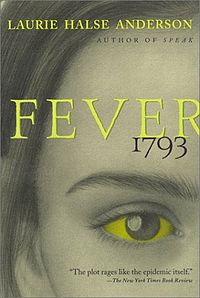
Over the course of the two evenings that I read the book, I found myself dreaming about Philadelphia and illness! Anderson’s descriptions and details were so vivid and strategically placed in the storyline (ex., the dress Mattie takes out of her mother’s chest when she runs out of clean clothes, the way the sun seemed to bake the cobbled stones of the city, the sights, sounds, and tastes from the open market, the vinegar-soaked clothes and sponges), that they imprinted on my subconcious mind. This is the mark of great historical fiction for me– being transported to a time period and landscape that I have never experienced in person.
In her author’s notes, Anderson answers several plausible questions her readers might have for her, inculding details about the fever and her inspiration for the story. It’s clear that she spent a great amount of time and care in researching the event to mine the details that would bring her story and characters to life.
Section:
L. Burkam, A. (2000). Fever 1793 [Review of book Fever 1793]. Horn Book Magazine, 76(5), 562-563.
Module 12: Hole in My Life
Summary:
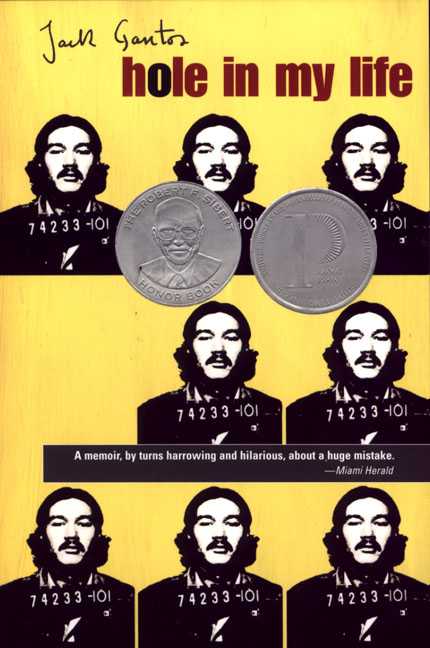
Jack Gantos loves books and loves writing, but as a mischievous, dreamy-eyed teenager, his determination and drive to get to college to study writing take him down a dangerous and criminal path; he agrees to help to smuggle a boat-load of drugs to Manhattan from the Virgin Islands. As a result, he serves his sentence in a federal prison, chronicling his days in a copy of Karamazov.
APA Reference:
Gantos, J. (2002). Hole in my life. New York, NY: Farrar, Straus and Girous.
Impressions:
It is a memoir about the author’s decisions that led to him being incarcerated in a federal prison at the age of nineteen for smuggling drugs from St. Croix to Manhattan. Gantos was received the Robert F. Sibert Honor Book and a Printz Honor Book awards for this title.
In the opening and the final chapters, Gantos takes the reader into his experience in a federal prison. He does not shield or protect teen readers from its realities (violence, rape, depression, drug use, etc.), but he doesn’t provide gratuitous and graphic details in excess either. The moments and scenes where he does get graphic are balanced with a sensitivity and profound revelation or reflection on the part of the author, making the overall message of the book that much more effective.
In his first chapter he writes, “Ironically, in spite of all the fear and remorse and self-loathing, being locked up in a prison is where I fully realized I had to change my life for the better, and in one significant way I did” (p. 7). Had he not slowed down and taken us into his world during these pivotal scenes, this message would not be as resounding.
In places the memoir reads like a travelogue, chronicling his days at sea with the cantankerous former British sailor, Hamilton. Gantos also honestly conveys his feelings of limbo, being neither here nor there. As a whole, the memoir is a compelling and sometimes cautionary coming-of-age story, warning of the impetuousness of youth and will appeal to a broad reader base of teens.
Professional Review:
Section:
GANTOS, Jack.
Hole in My Life.
Farrar. 2002.
Follos, A. (2004). Hole in My Life (Book) (Review of the book Hole in my life). School Library Journal, 50(11), 67.
Library Uses:
Hole in My Life would make an excellent selection for a book club for boys. Gantos’ style, humor, and realism might appeal to reluctant teenage boys, especially those with difficult pasts.
Module 11: How They Croaked
Summary:
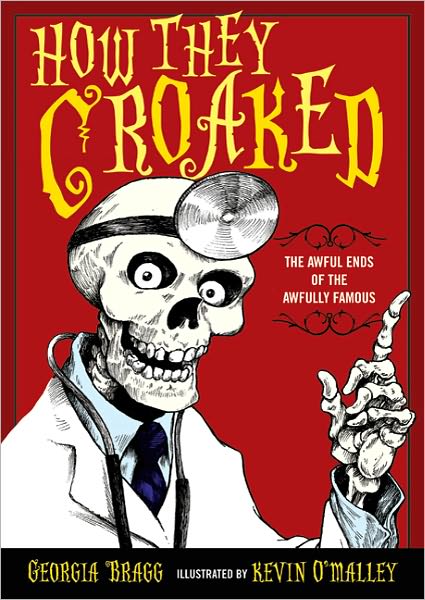
King Tut, George Washington, Cleopatra, Marie Curie–what do all of these great historical figures have in common? They all croaked, kicked the bucket, met their maker…they died. Not only did they die, but they died in some of the most strange, gruesome, and mysterious ways. This collection of biographies of the famous chronicles the lives of its subjects–often debunking or proving myths–and provides a scientific analysis of each of their deaths.
APA Reference:
Bragg, G (2011). How they croaked. New York, NY: Scholastic.
Impressions:
This title details the gruesome deaths of several famous figures including Queen Elizabeth, Pocahontas, Napoleon, Einstein, and many more. This title is a social science/ biography nonfiction book presented in chapters, one for each figure. The margins are wide and text is often accompanied with black and white drawings and figures that correlate with the subject matter.
Other than just being very informative, How They Croaked is a riot! The writing style incorporates colloquialisms and humor while providing the details and sometimes hilarious facts surrounding each death (King Henry VIII’s body exploded in his tomb because of the amount of infection and gasses that had built up in the layers of fat!)
At the end of each chapter the author provides little tid-bits and related facts such as all the different things that were named after Caesar (calendar, cesarean section, czar, Kaiser, etc.)
As an example of an excellent informational text, How They Croaked engages students through it’s relatable language, humorous tone, and related sketches. The brief chapters make for excellent read-alouds for students of all ages. Even our HOSA (Health Science Occupations) teacher came in and bought one for her class because of the direct tie-in with her curriculum.
Professional Review:
Danner, B. (2011). How they croaked: the awful ends of the awfully famous [Review of the book How they croaked: the awful ends of the awfully famous].School Library Journal, 57(4), 189-190.
Library Uses:
This book would be a very entertaining opening title for a book talk featuring biographies for young adults. A trailer could cleverly preview a few of the famous and their deaths.
- ← Previous
- 1
- 2
 (Re)Inventing the Librarian