Student Collaboration with Google Drive
1) One person does all the work. The high-achiever of the group grins and bears it as they carry the weight of the project.
From the other side of our various devices and locations strewn across the metroplex, we all shared a collective sigh and appreciation for the power of collaborative writing and tools such as Google Drive that breathe life and spirit in to the writing process.
So here’s the skinny on Google Drive:
1) It’s free. Doesn’t get any better than that.

Applications for learning:
Can we still have the same learning goals for students and their writing if they are participating in a collaborative essay or project that we would an individual assignment? YES! Do we address more learning goals by having them use technology to work collaboratively on a writing task? YES!
ISTE’s NETs for Students even address this skill as relevant and integral to today’s workforce and post-secondary environments:
| 2. | Communication and Collaboration | ||||||||
| Students use digital media and environments to communicate and work collaboratively, including at a distance, to support individual learning and contribute to the learning of others. Students: | |||||||||
|
Coming soon! My Big Campus allows you to integrate Google Drive as an application, much like it does Facebook and Twitter, which means that students can collaborate on Google Docs and more through one portal: MBC!
What is your personal experience with using Google Drive? Do you see any advantages for using it with students? Are there pitfalls or obstacles to integrating Google Drive into your learning activities?
Tech Tuesday: Google Earth

Google Earth: More than “Miss, I can see my house!”
I remember when I first learned about Google Earth. My students and I were fascinated by typing in our street address and zoom in so we could distinguish the roof of our school and then even the fence line of our backyards! A view of our own little world and community from space provided us with a new perspective into how we related to the world around us.
When I was really on fire about Google Earth, I would pull it up, type in the name of a city or address or continent and display it for my classes to help them understand the geographical context of a story or author we were studying. This was high-tech stuff for me as an English teacher.
But, Google Earth goes far beyond “you are here.” Did you know that Google Earth has features such as push pins, narration, tours, recording, annotation, embedding media, and so much more?! Check out the video to see some of the basic features while navigating in Google Earth.
For a hands-on experience, go to Tour of Google Earth’s features.
Of course, Google Earth is much, much more than merely zooming in and out to find landmarks. Below is a list of popular tools in GE and how they can be used in the classroom (borrowed from Google Earth’s Education Resources):
Classroom Resources: Features for My Class
Fly to the Sky: With Sky in Google Earth your students can explore Hubble telescope images, check out current astronomical events, study the proportions of different planets, measure their size, and observe the relative brightness of stars. You’ll capture the wonder of the universe without leaving your classroom. Learn More! Easy
View Historical Imagery: With the timeslider, view historical imagery to study the construction process of large buildings such as sports stadiums. You can also see how communities have developed by comparing the city layout of past and present. Learn More! Easy
View 3D Buildings :With 3D buildings Google Earth students have entire city landscapes at their finger tips. They can explore specific skyscrapers, public landmarks, famous ancient architecture, and even study city planning techniques and trends. With Google SketchUp students can recreate entire ancient cities within Earth. Learn More! Average
Draw and Measure: Discover the world’s tallest building or the world’s highest mountain peak by using the ruler tool to measure skyscrapers and mountains. You can mark off specific regions you have studied, or want to come back to using the polygon tool. Learn More! Average
Create a Tour: Students can create customized tours to share with their classmates. For example, they can build context around a novel by creating a tour of all the places mentioned in the book. Or, they can make a tour to highlight all the major rain-forests effected by deforestation. Learn More! Average
Google does a terrific job supporting educators and integrating Google tools into instruction. If you are curious about how Google Earth could be incorporated into your content area, check out the Projects for My Subject page.
Google Lit Trips
As an English teacher and librarian, I am particularly excited about Google Lit Trips! Teachers and students can browse the many Google Lit Trip tours already created to explore the geographical locations and landmarks in their favorite stories.
Here is a tour featuring the mythological and present day locations of The Odyssey. To view the tour, you will first need to download Google Earth and then download the kmz (Google Earth extension file name) for The Odyssey. Trust me–it is well worth the two clicks it takes to view it! The tour includes a 3D map of the locations along Odysseus’ journey, excerpts from the epic, photos, tour guides with facts and further details about each landmark, and more!
Not only can teachers and students browse the many Lit Trips already created, but they can create them as well for their favorite stories! For more video tutorials on creating Google Lit Trips check out YouTube and Vimeo!
Google Earth is also available as an app for a smart device, allowing students to view and create projects using their personal devices. Perhaps a Google Lit Trip or similar resource might make for a great Flipped classroom introduction or “View” in VESTED!
So let’s hear it! How could Google Earth be used in your content area?
Tech Tuesday #5
Google Custom Search Engines
 |
I ❤ Google! I love Google forms, Google docs, Google doodles, Google Scholar…the list goes on and on. And, I have a furvent longing to one day attend Google Teacher Academy, if I could ever get around to making that dang application video…Today, I love Google Custom Search Engine (google.com/cse). Let me tell you why:
Yesterday, I caught wind of a little research project being conducted in our English II pre-AP classes over a little book called Things Fall Apart by Chinua Achebe. The teacher graciously allowed me to take a look at the assigment handout, which led students through a webquest, exploring various topics relating to Nigerian history, culture, and the author himself. On the assignment page, specific websites were listed for students to access depending on their topic. I saw a library-infiltration opportunity and pounced!
(Time-out for a little soap-box on teaching students information and research skills.)
 |
| Used with permission from the creator, Sean Gallo, http://www.seangallo.com |
You may or may not be familiar with the addage, “How do you eat an elephant?…One bite at a time!” This is the image that comes to mind when I am asked, “How do you teach high school students to be critical consumers of information, digital citizens, and researchers?” One “byte” at a time, friends.
More often than not, research seems to be a “stop-and-do” unit of exhausting, lengthy days in the library or computer lab. Students and teachers spend days and weeks pounding away at research topics, meeting minimal requirements for number of sources, note cards, direct quotes, working toward completing a checklist of research tasks rather than engaging in transformative, authentic inquiry. Rather than pushing research back and back until afetr “the test” or reserving it until May when we’re eager to mark the days off of our calendars until summer, my proposition is this: let’s teach narrow and in depth–one bite at a time.
Google Custom Searches allow us to streamline one part of the inquiry process (exploring and searching) so that students can dig deeper into another part of the inquiry process. Here’s what you can do as a teacher or librarian to help “cut the meat” for our young researchers:
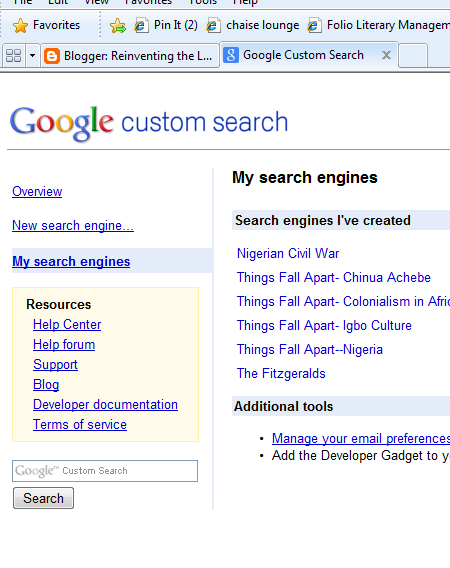
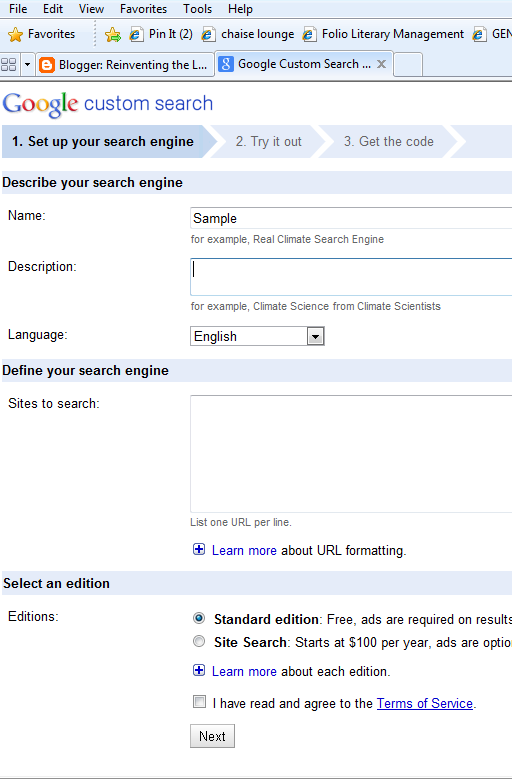 3. Give your search engine a title, description, and copy and paste websites that you have pre-selected as appropriate, credible sources for students to explore the topic in depth.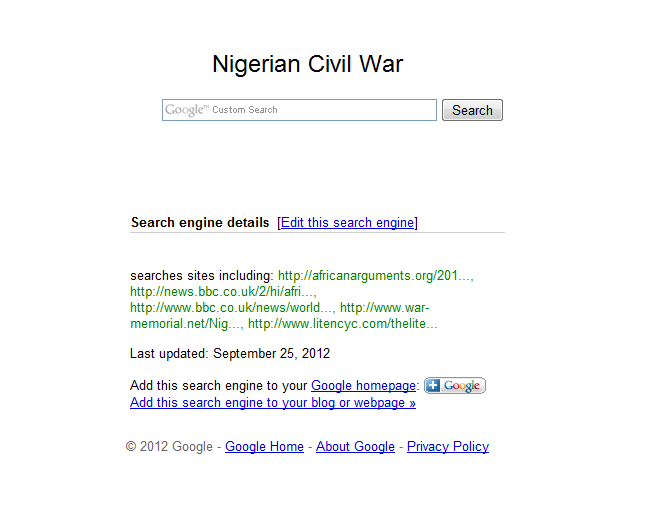
Sometimes we need to be a Momma-bird and do a little “pre-chewing” for our students to ease digestion (tired of the zoological metaphors??? Got it.) We can support students’ inquiry by providing them pre-selected sources so that they can then dedicate their attention to narrowing the focus of their inquiry, effective note-taking, documenting sources, synthesizing information, or presenting their understandings about the topic.
Would we want to give them a CSE everytime they do research? No, they need to learn to take the first bite, but perhaps we give them support in another area instead. Once they have all the smaller pieces mastered, then they can fully engage in the transformative power of inquiry-driven research…and fully enjoy the elephant in its entirety (couldn’t help it that one).
Talk to your librarian about collaborating to create Google Custom Search Engines for your next research adventure! Take a look at the library page I created to support students as they conducted research relating to Things Fall Apart. Special thanks to Christina Salcido and Erin Mathews for allowing me to crash their research party 🙂
Sneak peak for next week’s Tech Tuesday blog: Social bookmarking for student collaboration…Pinterest, Diigo, and Delicious
Check out some CSEs that I’ve created for various inquiry units:
 (Re)Inventing the Librarian