reviews
Writing as Readers–The Nonfiction Book Review
Quote Posted on Updated on
The Traditional Book Report Vs. Book Review
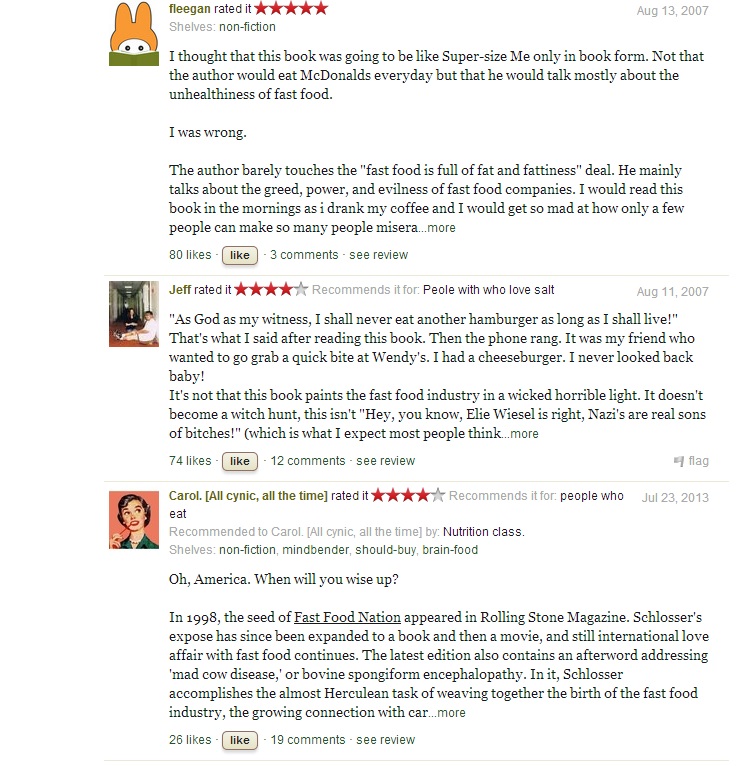
After a very successful day with students introducing them to nonfiction titles the stage was set.
Students were on their way to making their nonfiction book selections following the book speed-dating activity that I facilitated in the library.
The next question was, how can students demonstrate their experience and reactions to the book for their teacher and their classmates in a way that is both authentic and academic? The teacher who was collaborating with me on this adventure had been using a reading log as the primary tool for students to track and report their reading goals.
She was dissatisfied with the reading log as an assessment for a number of reasons:
1) It was easy to fake.
2) Not all books were created equal–in length. One 200 page book might be much more complex than a 400 page book. How were tracking page numbers an accurate reflection of the student’s reading experience?
3) The log did little to capture those magical moments that happen between a reader and the text. In fact, it did nothing.
4) The reading log didn’t feel “on-grade level” for the English I pre-AP teacher who strives to ensure that her assessments contained an appropriate amount of rigor.
To these I added a few of my own qualms after having used the reading log religiously for six years with my own classes:
1) The log imposed an artificial reading goal on students–a number of pages to be read.
2) It did nothing to foster and inspire a reading community.
3) I hated assigning grades to quantitative reading goals that I had imposed upon students.
It was decided; the reading log would be set aside for the purpose of our nonfiction experiment (*190 English I students collectively cheer, “hoorah!”).
When I brought up the idea of writing reviews, I could tell that the teacher had some hesitation. I sensed that, in her experience, reviews and reports brought back a certain amount of reading sentimentality. Sure, it was nice to hear how students felt about a book–if they liked it and so on– but like many of us my colleague was not interested in reading her students’ summaries of the books they had read. How could a simple book review adequately demonstrate their experience as readers?
How do we balance reader response and analytic writing?
We went to the standards to see if we could find a student expectation that captured the level of thinking as readers and writers we wanted to see in students. Sure enough, there it was:
Texas Essential Knowledge and Skills
15 (C) write an interpretative response to an expository or a literary text (e.g., essay or review) that:
(i) extends beyond a summary and literal analysis;
(ii) addresses the writing skills for an analytical essay and provides evidence from the text using embedded quotations; and
(iii) analyzes the aesthetic effects of an author’s use of stylistic or rhetorical devices
As a consummate consumer of reviews from blogs, websites, and journals, I’ve read wonderful reviews from passionate readers that balance authentic reading response and critical analysis.
Students came back to the library so that we could read and deconstruct these real-world reviews in order to craft them ourselves.
How do readers share with one another?
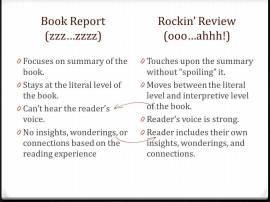
After a brief discussion on the difference between a book report and book review, we began by simply reading nonfiction book reviews posted on websites like Goodreads and Amazon. To engage them in the task of deconstructing a book review, I posed a very simple question to students: What sticks with you?
When we use mentor texts for writing, we begin by inviting students to identify the patterns in the text. As we identified something new in the review, I color-coded details. With my guidance, students created an anchor chart that identified four key concepts that they needed to understand about writing nonfiction reviews.
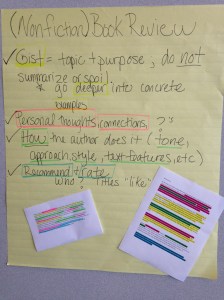
Our (not so pretty) anchor chart uses the mentor texts we analyzed and four key concepts to remember that coordinated with our color-coding. Not only did students have a visual reminder in their classroom of the writing task they were preparing for, but the teacher had a ready-made rubric to assess students’ writing.
Students would now go forth and read their books…but wait, what was going to happen between the this eye-opening day in the library and when they came back to write the reviews?
How could we intentionally scaffold and support students’ responses and reactions to their selected books in order to prepare them to write reflectively and critically?
It’s Monday! What are you reading? 1/21/13
 |
Overall, if was a fairly productive and satisfying reading week. I attended a conference over the weekend, however, that amplified my TBR list to include a healthy selection of nonfiction titles especially. So here’s my report:
Books I Finished:
Graceling by Kristin Cashore. Of course I adored Katsa’s chutzpah, her super-survival abilities, and her yummy un-boyfriend, Po. Since I finished it, I’ve had the nagging desire to change my calico cat’s name to Po. But seeing as how she’s not a boy, and Po probably would turn his nose up at that, I guess we’ll stick to Bebe afterall.
3.5 stars for an overall enjoyable story with some twists and depth of character, especially in the secondary character department (Bitterblue and even Leke), but nothing in her prose pushed me over the top.
The Fault in Our Stars by John Green. You all told me I would love it, and I harbored some doubts half-way through the book, but then there was Amsterdam (sigh). I think it was quite serendipitous, by the way, that I finished the book on its release date anniversary and the same date that John and Hank sold out Carnegie Hall with A Night of Awesome!
A hearty 5 out of 5 stars to one of my favorite “literary” YA books for its splendid treatment of a heart-wrenching subject, awesome characters, and awesome writing….awesome.
Currently Reading:
Jepp Who Defied the Stars by Katherine Marsh. I really am digging this sweet little book. I don’t feel compelled to rush my way through it, and even if I wanted to, I leave it in my special spot at the circulation desk to enjoy during 7th and 8th period after the lunch bunch has left for the day. Like I predicted, Marsh broke my heart, but I’m seeing a new adventure on the horizon and excited to see what is in store next for our little dwarf.
(Anyone else notice a pattern from last week…stars, fate, destiny…last week’s stack inspired me to start working on a review of “stars” books…so stay tuned!)
This Dark Endeavor by Kenneth Oppel. This guy is a prime example of my tendency to withhold certain books as reward since a friend “loaned” it to me over a year ago, and I’m just now reading it. The sequel, Such Wicked Intent came out this past August, so I figured it was time I got serious about this one. A pre-quel to Mary Shelley’s Frankenstein, what literature-loving-English-teacher-turned-librarian could pass this up! Speaking of chutzpah, Oppel’s reimagined Elizabeth has loads; I love her little asides about women’s lib, an homage to the original author’s activist mother I’m assuming. The quest narrative allows our imaginations to run wild as we see the seeds of obsession planted in young Victor’s mind….okay, I better finish this post so I can see what happens next!
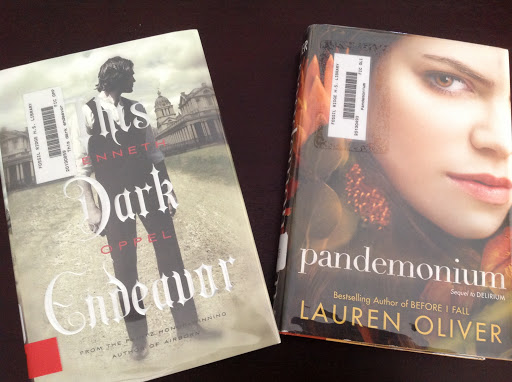
Pandemonium by Lauren Oliver. Oliver’s first book in this series, Delirium, did take me some getting in to before I was invested. I felt there was a surplus of exposition in the first installment–a criticism I usually reserve for the sophomore in a series. Much like Ally Condie’s Matched and Veronica Roth’s Insurgent, this series takes us to a dystopian future where society has re-organized itself around the eradication of the root of all evil, only this time the culprit is Love. Deliria Nervosa, as it the illness is known, is “cured” by an invasive procedure to the frontal lobe when a person turns sixteen. After gut-wrenching revelation and a heart-breaking decision at the finale of Delirium, Lena’s complexity is said to really develop once she finds herself alone at the start of the second book. I’m early in, but already I see potential for some serious evolution in character.
To Read:
My sources tell me that ALA will release their coveted book award honorees and winners lists soon! You know what that means–just like the pre-Oscar countdown, it’s time to read (or re-read) some of the hottest contenders:
Wonder by R.J. Palacio
The One and Only Ivan by Katherine Applegate

And to keep in touch with my YA base, how about Gae Polisner’s Pull of Gravity.
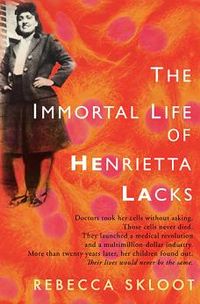
…And to work on my book gap challenge, let’s throw in some nonfiction with The Immortal Life of Henrietta Lacks by Rebecca Skloot.
Module 10: Fever 1793
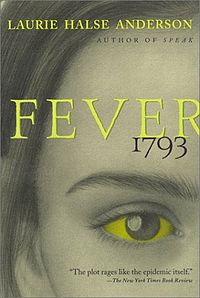
Over the course of the two evenings that I read the book, I found myself dreaming about Philadelphia and illness! Anderson’s descriptions and details were so vivid and strategically placed in the storyline (ex., the dress Mattie takes out of her mother’s chest when she runs out of clean clothes, the way the sun seemed to bake the cobbled stones of the city, the sights, sounds, and tastes from the open market, the vinegar-soaked clothes and sponges), that they imprinted on my subconcious mind. This is the mark of great historical fiction for me– being transported to a time period and landscape that I have never experienced in person.
In her author’s notes, Anderson answers several plausible questions her readers might have for her, inculding details about the fever and her inspiration for the story. It’s clear that she spent a great amount of time and care in researching the event to mine the details that would bring her story and characters to life.
Section:
L. Burkam, A. (2000). Fever 1793 [Review of book Fever 1793]. Horn Book Magazine, 76(5), 562-563.
Module 12: Hole in My Life
Summary:
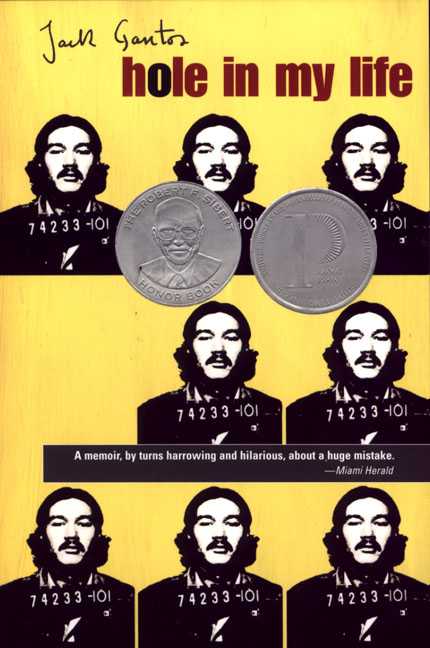
Jack Gantos loves books and loves writing, but as a mischievous, dreamy-eyed teenager, his determination and drive to get to college to study writing take him down a dangerous and criminal path; he agrees to help to smuggle a boat-load of drugs to Manhattan from the Virgin Islands. As a result, he serves his sentence in a federal prison, chronicling his days in a copy of Karamazov.
APA Reference:
Gantos, J. (2002). Hole in my life. New York, NY: Farrar, Straus and Girous.
Impressions:
It is a memoir about the author’s decisions that led to him being incarcerated in a federal prison at the age of nineteen for smuggling drugs from St. Croix to Manhattan. Gantos was received the Robert F. Sibert Honor Book and a Printz Honor Book awards for this title.
In the opening and the final chapters, Gantos takes the reader into his experience in a federal prison. He does not shield or protect teen readers from its realities (violence, rape, depression, drug use, etc.), but he doesn’t provide gratuitous and graphic details in excess either. The moments and scenes where he does get graphic are balanced with a sensitivity and profound revelation or reflection on the part of the author, making the overall message of the book that much more effective.
In his first chapter he writes, “Ironically, in spite of all the fear and remorse and self-loathing, being locked up in a prison is where I fully realized I had to change my life for the better, and in one significant way I did” (p. 7). Had he not slowed down and taken us into his world during these pivotal scenes, this message would not be as resounding.
In places the memoir reads like a travelogue, chronicling his days at sea with the cantankerous former British sailor, Hamilton. Gantos also honestly conveys his feelings of limbo, being neither here nor there. As a whole, the memoir is a compelling and sometimes cautionary coming-of-age story, warning of the impetuousness of youth and will appeal to a broad reader base of teens.
Professional Review:
Section:
GANTOS, Jack.
Hole in My Life.
Farrar. 2002.
Follos, A. (2004). Hole in My Life (Book) (Review of the book Hole in my life). School Library Journal, 50(11), 67.
Library Uses:
Hole in My Life would make an excellent selection for a book club for boys. Gantos’ style, humor, and realism might appeal to reluctant teenage boys, especially those with difficult pasts.
Book Review: A Monster Calls
I’ve become a magnet. A magnet to stories, blogs, novels, anything regarding parents and children, especially mothers and their sons. It feels like there’s been an explosion on Facebook of blogs reposted by friends of families who have experienced the loss of a child or a parent. Their stories lead me to my knees, humbled in the face of my fear.
My fear is two-fold:
1) That I will lose my son.
2) That my son will lose me.
The truth of the matter is- unless a freak and tragic accident takes us both at the same time (God forbid)- one of us will lose the other in our lifetime. And this is the thought that wakes me up at night and that draws me to stories of loss.
Today, a friend reposted a blog of a mother whose toddler son died from a heart arhythmia during his regular nap.
A couple of months ago, a friend reposted a blog of a husband and father of two young boys, whose wife died very suddenly last fall.
I read their stories and beg…whoever is out there to beg…that it not be me and my son.
Recently, I read Patrick Ness’s A Monster Calls. This superb, lovely, painful little book has haunted me ever since. As the main character’s mother is dying from cancer, he struggles to satiate the monster who calls on him every night at the same time. At a certain point in the book, the boy steps into the monster and becomes him, wreaking havoc and destruction on his enemies. And yet, this is not the monster that he fears the most. What he fears the most is fear itself. Fear that what he truly wants is for his mother to die to end her pain. Fear that his mother will die. Fear that, when the time comes, he cannot let her go.
At night, when the shadows reach across the bed from the tree outside my window, I can feel the yew’s prickly branches and its spicy, woody scent fills my nose.
I know one day that my fear will be realized. Until then, I’ll keep reading. I read to find solace in the inexplicable connection grief can weave between strangers. I read to unearth glints of understanding and patterns to try to ratioanlize why a mother would ever have to lose a child or a child ever to have to live without its mother. But I know that just as this Winter will turn to Spring, there is life on the otherside. It’s a life I never want to understand.
But until then, I’ll read.
My fear does bring me joy. It’s started to become my companion during the day, especially when a toddler tantrum raises feelings of frustration. My fear whispers, “someday, these moments will be memories. Someday your arms will ache to wrap themselves around him and he will not be there. Someday he will long to hear you say his name and whisper, “I love you,” but you will not be there.” And so, in those moments and every moment in between I will say his name and whisper as I wrap my arms around him, “I love you. I love you. I love you.”
 (Re)Inventing the Librarian