SLIS 5420
Module #8: The Raven Boys
 Summary:
Blue has been told since she was very young that she will kill her true love. While watching the ghosts of the soon-to-be-dead walk through churchyard endowed with tremendous spiritual energy, she’s drawn to one spirit, a mysterious boy who speaks directly to her, “Gansey, that’s all there is.” She undergoes a quest with the real Gansey and his three Raven Boys, all students at the prestigious Aglionby Academy, to unearth the powerful ley line and unlock the mystery before someone else beats them to it.
APA Reference:
Stiefvater, M. (2012). The raven boys. New York, NY: Scholastic Press.
Professional Review:
Fiction * The Raven Boys Maggie Stiefvater Scholastic Press, $18.99 (416p) ISBN 978-0-545-42492-9
The Raven Boys [Review of the book The raven boys]. (2012). Publishers Weekly, 259(31), 67.
Impressions:
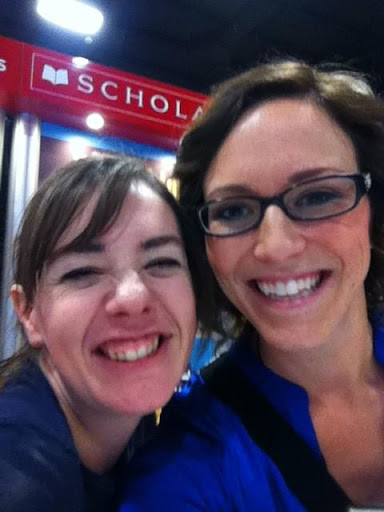 |
| My “BFF” Maggie and Me at NCTE12 |
After devouring Stiefvater’s series The Wolves of Mercy Falls, and her 2011 Printz Honor Book The Scorpio Races, I–and much of the YA-obsessed world–waited eagerly for the release of her “boy” series. Our patience was dually rewarded with this spectaculary, multi-dimensional ensemble story of a band of misfits and their supernatural quest. Much like in The Scorpio Races, Stiefvater deftly crafts a world based in realism with supernatural or mystical elements. Her prose is so well crafted that the reader forgets where the realism ends and fantasy begins. Whether it be ley lines, psychics, and deadly rituals or mythological man-eating water horses, her books do not leave the reader on the outside edge looking into a fantasy.
The ensemble cast of characters truly makes this a “character-driven” novel. Although at times I found myself doubling back and re-reading following abrupt perspectives to the story, I appreciated each character’s unique history, puzzles, and purposes for the quest.
I’m very eager to continue on with Blue in her boys in the next installment.
Favorite moments:
“She recognized the strange happiness that came from loving something without knowing why you did, that strange happiness that was sometimes so big that it felt like sadness.”
“When Gansey was polite, it made him powerful. When Adam was polite, he was giving power away.”
“I guess I make things that need energy stronger. I’m like a walking battery.”
“You’re the table everyone wants at Starbucks,” Gansey mused as he began to walk again.
Blue blinked. “What?”
Over his shoulder, Gansey said, “Next to the wall plug.”
“Where do you live?”
Adam’s mouth was very set. “A place made for leaving”
“That’s not really an answer.”
“It’s not really a place.”
“My words are unerring tools of
destruction, and I’ve come unequipped with the ability to disarm them.”
Library Uses:Both The Raven Boys and The Scorpio Races would make for an excellent bridge between readers who typically enjoy realistic fiction into the fantasy genre. Host a “meet the author” event featuring a new author who has made a strong impact in their genre. Show trailers, provide book talks for participating classes, and invite students to explore Maggie Stiefvater’s website for behind the scene videos into the making of her book trailers for a unique perspective on digital storytelling (www.maggiestiefvater.com).
Module 14: You Don’t Even Know Me
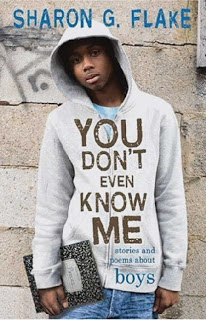
Summary
In this collection of stories and poetry all told from the perspective of teenage boys, Flake presents the sometimes hilarious but reflective voices that are not always heard in classrooms. Some stories deal with very serious topics such as teenage pregnancy and marriage and some are light-hearted takes on girls and how to impress them.
APA Reference
Flake, S. G. (2010). You don’t even know me. New York, NY: Jump at the Sun.
Professional Review
You don’t even know me. Sharon G. Flake. Jump at the Sun, 2010. $16.99. 978-1-4231-0014-0. Grades 8-11. Realistic, sometimes gritty, short stories and some poetry convey life for black, mostly urban, teenage boys. With different formats and themes, the narratives touch on teen pregnancy, AIDS, and violence but also convey a sense of hope and the richness of life.
Impressions
While reading this collection I most appreciated the diversity of the voices represented. Urban male teens tend to be pigeon-holed into one stereotype in pop culture–the hardened thug. Flake, however, shows us the hopes, zeal for life, and the importance of relationships to urban boys.
Library Uses
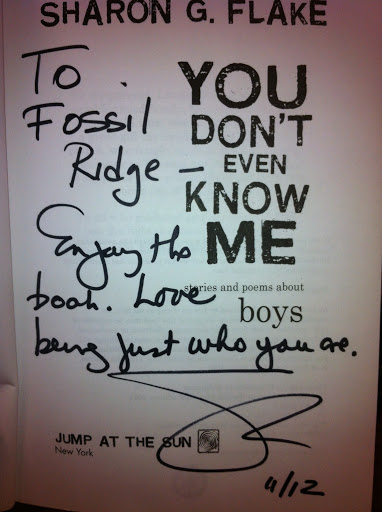
During National Poetry Month in April, the library can host an open-mic event for students to read from their favorite poets or read their own works. Leading up to the event, create a display of poetry students might find engaging. You Don’t Even Know Me can be part of a display geared towards boys finding their voices through poetry alongside The Rose That Grew From Concrete by Tupac Shakur and many other collections of poetries by urban and male voices. Flake’s poems or stories would make excellent podcasts, recorded with photographs depicting some of the images and scens in the poems.
Module #5: The First Part Last

Summary:
Bobby and his girlfriend Nia are in love and happy, until Nia discovers she is pregnant. Told in alternating chapters between “Now,” Bobby struggles to take care of his newborn daughter without the presence of Nia, and “Then,” Bobby and Nia struggle together to determine what will be best–keep the baby or put her up for adoption. It’s the “first part” of the story that is kept until the very end when we fully understand the situation Bobby finds himself in and the greatest struggle of all.
APA Reference:
Johnson, A. (2003). The first part last. New York, NY: Simon & Schuster Books for Young Readers.
Professional Review:
Section: Grades 9-12
JOHNSON, Angela. The First Part Last.
144p. CIP. S & S. 2003. RTE $15.95.
ISBN 0-689-84922-2. LC 2002036512.
The First Part Last (Book) [Review of the book The first part last]. (2004). School Library Journal, 5064.
Impressions:
First Part Last is such a gentle book, with a deeply sensitive narrator. Reluctant readers will enjoy the short, engaging chapters and the realistic setting and situations. Many will also find familiarity with Bobby’s struggle to be a single, teenage father and the heart-breaking loss he keeps tucked away.
Library Uses:
Paired alongside Flake’s You Don’t Even Know Me, this title could be part of a book talk that targets adolescent boys, particularly those who seem to hide a lot behind the “tough guy” facade.
Module 15: Forever
Summary
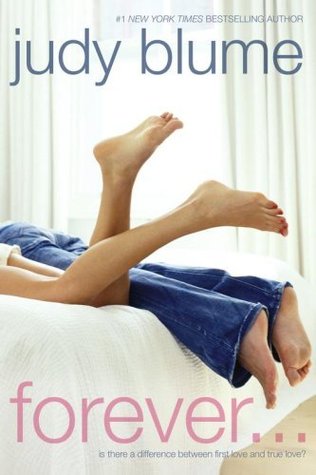
A senior in high school, Kath meets Michael at a friend’s New Year’s Eve party and nineteen dates later, they are in love. This isn’t just any kind of love; it’s the kind that lasts forever. The two are inseparable, as Kath works through her confusions and fears about sex and what “making love” will mean for them as a couple. A summer apart tests their trust in one another and belief in “forever.”
APA Reference
Blume, J. (1975). Forever. New York: NY, Atheneum Books for Young Readers.
Professional Review
Katherine and Michael find each other, and it’s first love for both of them. Katherine loses her virginity, finds out about contraceptives, and learns about VD with lectures inserted as needed. Actually, both kids are so kind and considerate, so understanding, so everything, that readers may wonder what’s wrong with them. Finally, she realizes that first love isn’t always Forever, that she is growing and accepting changes. Sniff, sniff. Obviously it’s not a quality book, but that fact won’t bother the many girls who will read it, identify, cry happily, and recommend it to their friends. Librarians buying for junior high schools should be aware that the sexual scenes, while not at all explicit compared to the run of adult novels, may be more than parents of young teens bargain for. —Regina Minduri, Alameda County Library, Hayward, Calif.
Made famous by the many challenges and attempts to ban it from school and public libraries, Blume’s novel is not just about sexual awakening, but of the universal experience of “true” and “first” love; oftentimes, teens first adult experiences are wrapped up in those relationships.
What I most appreciated about Forever is the expansive cast of female characters who all explore varying issues and angles to sexuality: Kath’s best friend Erica who makes it a goal to “get laid” before she goes to college so she can have the experience behind her; Kath’s grandmother, a New York lawyer, who played a pivotal role in the development of Planned Parenthood and sends her pamphlets about birth control, reproductive rights, and venereal disease in the mail, which ultimately leads to Kath visiting the clinic for contraceptives; and, Kath’s mother who has an open and honest relationship with Kath and does not shy away from having non-judgmental conversations about sex without condemning or condoning.
Are there somewhat erotic and overtly sexual moments in Forever? Oh, yes! But, even though sex is an ever present topic, the perspectives and reflections of the characters present a well-rounded conversation that every teenager could benefit from participating in. For some, the only way that will happen is through reading the book.
Library Uses
Forever is an excellent title that appears on the most frequently banned books lists that could be included in a display, book talk, or trailer promoting Banned Book Week. Given the popularity of Judy Blume’s work over the generations, the library could collect personal responses to the novel from adult and teen readers spanning the three decades the book has been popular.
Module #7: Mockingbirds

Book Summary
Alex wakes up in a strange dorm room with a strange boy, evidence of the previous night’s events scattered across the room. It’s clear what happened, but Alex has no memory of any of it after leaving the concert with her friends. As pieces of her memory come back to her and she confides in her best friend and her sister, she realizes the truth–she was date raped. She can stay quiet about it, try to move on with her life, or she can find someone who can help her take a stand. She seeks the assistance of a student organization, The Mockingbirds–named after Harper Lee’s To Kill a Mockingbird. Will they right the wrongs inflicted upon students by fellow students, or will Alex be left standing alone in the end?
APA Reference
Whitney, D. (2012). The mockingbirds. New York, NY: Little Brown.
ImpressionsThe opening chapter as Alex rises from a stranger’s bed, naked and disoriented, paints the picture of a too familiar scene. Whitney approaches the sensitive and sometimes taboo topic of date rape with an honest victim’s perspective. When Alex realizes what has happened to her, we wonder why she doesn’t fight harder, tell the authorities or her parents. Whitney constructs Alex in a way where we not only understand, but we empathize with the many stages of grief she must wade through following a traumatic event. Perhaps the most poignant scene comes right on the heals of resolution. Alex confides in the one adult she trusts to counsel her that she doubts herself and the accusations she’s brought against another student. A vague memory surfaces of that night that makes her question the whole course of events. This realism and honesty stems from Whitney’s personal experiences, which breathe purpose and heroism into her debut novel.
Professional Review
Section: The Book Review
Lehman, C. (2011). The Mockingbirds [Review of the book The Mockingbirds]. School Library Journal, 57(3), 175.
Library Uses
The Mockingbirds fits well with additional titles that address social justice and standing up for those who are dis-empowered. Paired with other books that deal with difficult topics for teens such as Speak by Laurie Halse Anderson, Lay that Trumpet in Our Hands by Susan Carol McCarthy, and Harper Lee’s iconic work, these books allow students to safely explore complex themes. The library may promote these titles by timing a book talk or display with the English department’s study of To Kill a Mockingbird.
Module #6: Click, Clack, Moo: Cows That Type
Book Summary
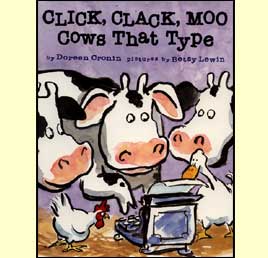
What happens when the cows on Farmer Brown’s farm learn to read and write and type? They leave notes demanding certain improvements, of course.
APA Reference
Cronin, D. (2000). Click, clack, moo: cows that type. New York, NY: Simon &Schuster Books for Young Readers
Impressions
Cronin’s humorous story of barnyard animals who band together over a typewriter and their new-found delight in the power of sending messages delights young readers, teens, and adults. Lewin’s water color images with bold tracings convey the expressiveness of both Farmer Brown and his animals as messages are sent and received. The simply repeated phrase, “click, clack, moo” sets the book’s light-hearted rhythm, inviting readers to participate whenever the familiar stanza appears, accentuated with large and bold font. Older readers might even recognize some parallel’s with George Orwell’s Animal Farm and enjoy discussing the irony of Farmer Brown’s situation and the pigs from the classical novel.
Professional Reviews
Section: Focus On: COMMUNITY
CRONIN, Doreen.
Click, Clack, Moo: Cows That Type.
illus. by Betsy Lewin.
S. & S. 2000.
RTE $15.95. ISBN 0-689-83213-3.
Auerbach, B. (2005). Click, clack, moo: cows that type [Review of the book Click, clack, moo: cows that type]. School Library Journal, 51(9), 58.
Library Uses
Use this text alongside Doreen Cronin and Betsy Lewin’s other works including Duck for President and Giggle, Giggle, Quack (all which take place in Farmer Brown’s barnyard) for students to explore the work of one author/ illustrator team more in depth.
Module 13: Tales from Outer Suburbia
Summary:
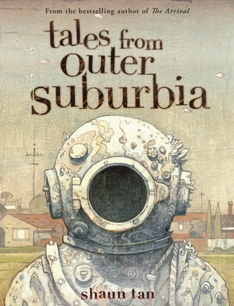
Shaun Tan explores many of the themes and issues present in modern day suburbia through a collection of comic, illustrated stories and sketches. The stories are presented through a satirical lens and offer the the reader a sophisticated but humorous examination of suburban lifestyle.
APA Reference:
Taun, S. (2008). Tales from outer suburbia. New York, NY: Arthur A. Levine Books.
Professional Review:
Section:
TAN, Shaun.
Tales from Outer Suburbia.
illus. by author. 96p. Scholastic/Arthur A. Levine Bks.
2009. Tr $19.99. ISBN 978-0-545-05587-1.
LC number unavailable.
Tales from outer suburbia [Review of the book Tales from outer suburbia]. (2009). School Library Journal, 5540.
Impressions:
Unlike his award-winning The Arrival, which focuses on a singular plot and cast of characters, Tales uses a series of short vignettes, some not even prose, to explore fantastical stories of stick people, whales beached in backyards, and even a “how-to” grow your perfect pet. Even taking the graphics out of consideration, the text alone in this work would not warrant the label “novel.” But, because it has illustrations, we are quick to place it in the graphic novel genre.
Readers who enjoy illustrated texts that invite deeper exploration in the graphics and images will enjoy this book. The quirky alien neighbors and random how-toinfluences provide some laugh-out-loud moments as well as moments for further consideration where you may even stop to wonder if Tan is sneaking in a social commentary of some sort in between his more light-heared sic-fi moments.
Library Uses:
This title is an excellent discussion starter for graphic novels as a genre. Invite students to explore how this book is organized, the role of the graphics and the text, the multiple story lines and modes of writing, and them invite them to compare this to more linear-styled graphic novels such as The Invention of Hugo Cabret by Brian Selznick or any number of more traditional graphic novels.
Module 10: Fever 1793
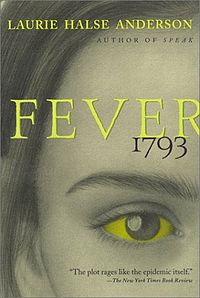
Over the course of the two evenings that I read the book, I found myself dreaming about Philadelphia and illness! Anderson’s descriptions and details were so vivid and strategically placed in the storyline (ex., the dress Mattie takes out of her mother’s chest when she runs out of clean clothes, the way the sun seemed to bake the cobbled stones of the city, the sights, sounds, and tastes from the open market, the vinegar-soaked clothes and sponges), that they imprinted on my subconcious mind. This is the mark of great historical fiction for me– being transported to a time period and landscape that I have never experienced in person.
In her author’s notes, Anderson answers several plausible questions her readers might have for her, inculding details about the fever and her inspiration for the story. It’s clear that she spent a great amount of time and care in researching the event to mine the details that would bring her story and characters to life.
Section:
L. Burkam, A. (2000). Fever 1793 [Review of book Fever 1793]. Horn Book Magazine, 76(5), 562-563.
Module 12: Hole in My Life
Summary:
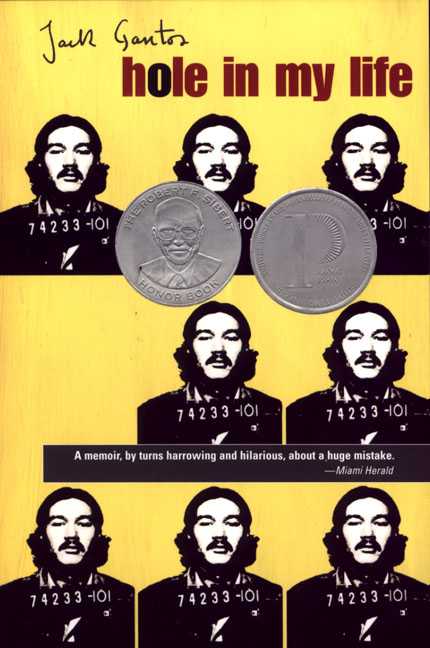
Jack Gantos loves books and loves writing, but as a mischievous, dreamy-eyed teenager, his determination and drive to get to college to study writing take him down a dangerous and criminal path; he agrees to help to smuggle a boat-load of drugs to Manhattan from the Virgin Islands. As a result, he serves his sentence in a federal prison, chronicling his days in a copy of Karamazov.
APA Reference:
Gantos, J. (2002). Hole in my life. New York, NY: Farrar, Straus and Girous.
Impressions:
It is a memoir about the author’s decisions that led to him being incarcerated in a federal prison at the age of nineteen for smuggling drugs from St. Croix to Manhattan. Gantos was received the Robert F. Sibert Honor Book and a Printz Honor Book awards for this title.
In the opening and the final chapters, Gantos takes the reader into his experience in a federal prison. He does not shield or protect teen readers from its realities (violence, rape, depression, drug use, etc.), but he doesn’t provide gratuitous and graphic details in excess either. The moments and scenes where he does get graphic are balanced with a sensitivity and profound revelation or reflection on the part of the author, making the overall message of the book that much more effective.
In his first chapter he writes, “Ironically, in spite of all the fear and remorse and self-loathing, being locked up in a prison is where I fully realized I had to change my life for the better, and in one significant way I did” (p. 7). Had he not slowed down and taken us into his world during these pivotal scenes, this message would not be as resounding.
In places the memoir reads like a travelogue, chronicling his days at sea with the cantankerous former British sailor, Hamilton. Gantos also honestly conveys his feelings of limbo, being neither here nor there. As a whole, the memoir is a compelling and sometimes cautionary coming-of-age story, warning of the impetuousness of youth and will appeal to a broad reader base of teens.
Professional Review:
Section:
GANTOS, Jack.
Hole in My Life.
Farrar. 2002.
Follos, A. (2004). Hole in My Life (Book) (Review of the book Hole in my life). School Library Journal, 50(11), 67.
Library Uses:
Hole in My Life would make an excellent selection for a book club for boys. Gantos’ style, humor, and realism might appeal to reluctant teenage boys, especially those with difficult pasts.
Module 11: How They Croaked
Summary:
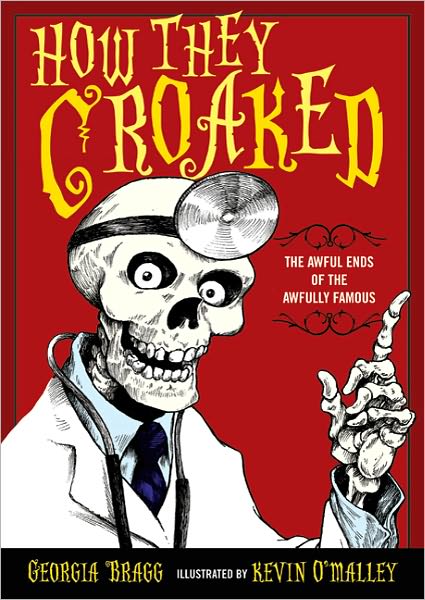
King Tut, George Washington, Cleopatra, Marie Curie–what do all of these great historical figures have in common? They all croaked, kicked the bucket, met their maker…they died. Not only did they die, but they died in some of the most strange, gruesome, and mysterious ways. This collection of biographies of the famous chronicles the lives of its subjects–often debunking or proving myths–and provides a scientific analysis of each of their deaths.
APA Reference:
Bragg, G (2011). How they croaked. New York, NY: Scholastic.
Impressions:
This title details the gruesome deaths of several famous figures including Queen Elizabeth, Pocahontas, Napoleon, Einstein, and many more. This title is a social science/ biography nonfiction book presented in chapters, one for each figure. The margins are wide and text is often accompanied with black and white drawings and figures that correlate with the subject matter.
Other than just being very informative, How They Croaked is a riot! The writing style incorporates colloquialisms and humor while providing the details and sometimes hilarious facts surrounding each death (King Henry VIII’s body exploded in his tomb because of the amount of infection and gasses that had built up in the layers of fat!)
At the end of each chapter the author provides little tid-bits and related facts such as all the different things that were named after Caesar (calendar, cesarean section, czar, Kaiser, etc.)
As an example of an excellent informational text, How They Croaked engages students through it’s relatable language, humorous tone, and related sketches. The brief chapters make for excellent read-alouds for students of all ages. Even our HOSA (Health Science Occupations) teacher came in and bought one for her class because of the direct tie-in with her curriculum.
Professional Review:
Danner, B. (2011). How they croaked: the awful ends of the awfully famous [Review of the book How they croaked: the awful ends of the awfully famous].School Library Journal, 57(4), 189-190.
Library Uses:
This book would be a very entertaining opening title for a book talk featuring biographies for young adults. A trailer could cleverly preview a few of the famous and their deaths.
 (Re)Inventing the Librarian