YA
Module 13: Tales from Outer Suburbia
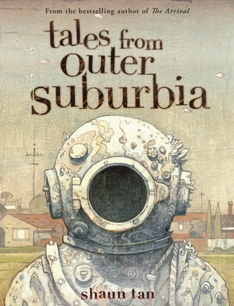
Summary:
Shaun Tan explores many of the themes and issues present in modern day suburbia through a collection of comic, illustrated stories and sketches. The stories are presented through a satirical lens and offer the the reader a sophisticated but humorous examination of suburban lifestyle.
APA Reference:
Taun, S. (2008). Tales from outer suburbia. New York, NY: Arthur A. Levine Books.
Professional Review:
Section:
TAN, Shaun.
Tales from Outer Suburbia.
illus. by author. 96p. Scholastic/Arthur A. Levine Bks.
2009. Tr $19.99. ISBN 978-0-545-05587-1.
LC number unavailable.
Tales from outer suburbia [Review of the book Tales from outer suburbia]. (2009). School Library Journal, 5540.
Impressions:
Unlike his award-winning The Arrival, which focuses on a singular plot and cast of characters, Tales uses a series of short vignettes, some not even prose, to explore fantastical stories of stick people, whales beached in backyards, and even a “how-to” grow your perfect pet. Even taking the graphics out of consideration, the text alone in this work would not warrant the label “novel.” But, because it has illustrations, we are quick to place it in the graphic novel genre.
Readers who enjoy illustrated texts that invite deeper exploration in the graphics and images will enjoy this book. The quirky alien neighbors and random how-toinfluences provide some laugh-out-loud moments as well as moments for further consideration where you may even stop to wonder if Tan is sneaking in a social commentary of some sort in between his more light-heared sic-fi moments.
Library Uses:
This title is an excellent discussion starter for graphic novels as a genre. Invite students to explore how this book is organized, the role of the graphics and the text, the multiple story lines and modes of writing, and them invite them to compare this to more linear-styled graphic novels such as The Invention of Hugo Cabret by Brian Selznick or any number of more traditional graphic novels.
Module 10: Fever 1793
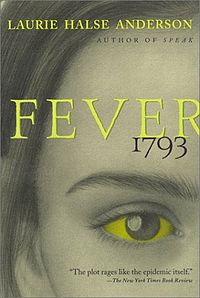
Over the course of the two evenings that I read the book, I found myself dreaming about Philadelphia and illness! Anderson’s descriptions and details were so vivid and strategically placed in the storyline (ex., the dress Mattie takes out of her mother’s chest when she runs out of clean clothes, the way the sun seemed to bake the cobbled stones of the city, the sights, sounds, and tastes from the open market, the vinegar-soaked clothes and sponges), that they imprinted on my subconcious mind. This is the mark of great historical fiction for me– being transported to a time period and landscape that I have never experienced in person.
In her author’s notes, Anderson answers several plausible questions her readers might have for her, inculding details about the fever and her inspiration for the story. It’s clear that she spent a great amount of time and care in researching the event to mine the details that would bring her story and characters to life.
Section:
L. Burkam, A. (2000). Fever 1793 [Review of book Fever 1793]. Horn Book Magazine, 76(5), 562-563.
Module 12: Hole in My Life
Summary:
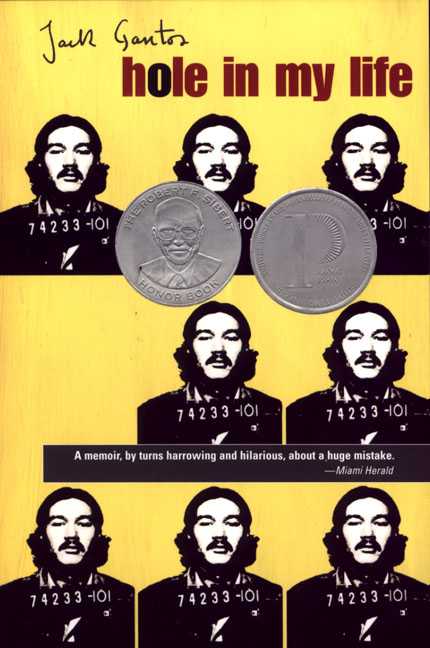
Jack Gantos loves books and loves writing, but as a mischievous, dreamy-eyed teenager, his determination and drive to get to college to study writing take him down a dangerous and criminal path; he agrees to help to smuggle a boat-load of drugs to Manhattan from the Virgin Islands. As a result, he serves his sentence in a federal prison, chronicling his days in a copy of Karamazov.
APA Reference:
Gantos, J. (2002). Hole in my life. New York, NY: Farrar, Straus and Girous.
Impressions:
It is a memoir about the author’s decisions that led to him being incarcerated in a federal prison at the age of nineteen for smuggling drugs from St. Croix to Manhattan. Gantos was received the Robert F. Sibert Honor Book and a Printz Honor Book awards for this title.
In the opening and the final chapters, Gantos takes the reader into his experience in a federal prison. He does not shield or protect teen readers from its realities (violence, rape, depression, drug use, etc.), but he doesn’t provide gratuitous and graphic details in excess either. The moments and scenes where he does get graphic are balanced with a sensitivity and profound revelation or reflection on the part of the author, making the overall message of the book that much more effective.
In his first chapter he writes, “Ironically, in spite of all the fear and remorse and self-loathing, being locked up in a prison is where I fully realized I had to change my life for the better, and in one significant way I did” (p. 7). Had he not slowed down and taken us into his world during these pivotal scenes, this message would not be as resounding.
In places the memoir reads like a travelogue, chronicling his days at sea with the cantankerous former British sailor, Hamilton. Gantos also honestly conveys his feelings of limbo, being neither here nor there. As a whole, the memoir is a compelling and sometimes cautionary coming-of-age story, warning of the impetuousness of youth and will appeal to a broad reader base of teens.
Professional Review:
Section:
GANTOS, Jack.
Hole in My Life.
Farrar. 2002.
Follos, A. (2004). Hole in My Life (Book) (Review of the book Hole in my life). School Library Journal, 50(11), 67.
Library Uses:
Hole in My Life would make an excellent selection for a book club for boys. Gantos’ style, humor, and realism might appeal to reluctant teenage boys, especially those with difficult pasts.
Module #5: Ship Breaker
Book Summary
Nailer was born a scavenger and will most likely die one. In fact, he comes very near to drowning in a pitch-black oil reservoir in the belly of the beached tanker he is scavenging for copper when a “lucky strike” leads him to an escape hatch, spilling hundreds of gallons of “black gold” onto the beach. That evening a terrible storm hits the beach where the scavengers live, ripping apart tents and threatening to drown anyone in its path. The storm brings with it a new treasure, a high-tech, fast-sailing clipper ship with very precious cargo, a girl. Nailer must decide if he will stay true to his roots and give up the girl or see her safely returned to her tycoon father.
APA Reference
Bacigalupi, P. (2010). Ship breaker. New York, NY: Little Brown.
Impressions
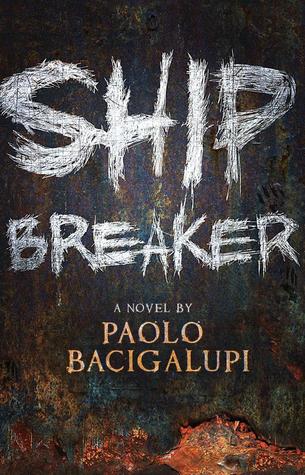
Everything involved with the actual reading experience of this book feels true to its content: the slick, book cover with copper glinting through a sheen of oil; Nailer’s rough and “survival of the fittest” exterior coupled with his true heroic nature; and the epic journey across the Gulf Coast Region that lay in waste following years of man-made abuse. Nailer’s addict father is absolutely terrifying; Bacigalupi succeeds in convincing me that he would easily gut his own son without a second thought or ounce of remorse. The final confrontation between Nailer and his father leaves the reader breathless and slightly heartbroken as he wrestles with the consequences of his actions. His conflicting emotions and motivations for rescuing “Lucky Girl” and the magnetism between the two reminds me of the remarkable relationship between Todd and Viola in Patrick Ness’ The Knife of Never Letting Go, another post-apocalyptic, science fiction coming of age epic. Ship Breaker however raises relevant questions regarding mankind’s insatiable thirst for resources, the impact on the planet, and the greater impact on the individual.
Professional Review
Section: Multimedia Review
Wysocki, B. (2011). Ship Breaker [Review of the book Ship breaker]. School Library Journal, 57(3), 78-79.
Library Uses
This title would make an excellent companion to other post-apocalyptic novels exploring questions of survival and individuality such as Lord of the Flies, The Eleventh Plague by Jeff Hersch, and After the Snow by S.D. Crockett. A book talk featuring these titles and others might help readers venture further into science fiction, dystopian, and futuristic novels.
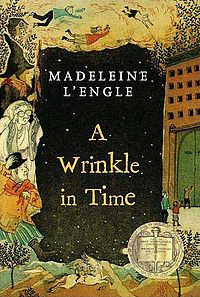
Module #4: A Wrinkle in Time
Summary
Meg and her young brother charles, together with a new friend, Calvin, embark on an adventure to save their father who had been experimenting with time travel. As they encounter the most evil forces traveling through space and the most benevolent allies, Meg, Charles, and Calvin must rely on their unique talents and gifts and ties to one another to save Mr. Wallace and find a way back to Earth in time to save it from the darkness.
APA Reference
L’Engle, M. (1962). A wrinkle in time. New York, NY: Random House.
Impressions
It’s difficult to add to the immense amount of reflections and critiques of this work. Often hailed as the original science fiction for children, L’Engle’s famous novel has been dissected, discussed, and passed from reader to reader with enthusiasm and joy for years and will be for years to come. As I was reading it, I felt sad that I did not experience it the first time as a child or even young adult. As an adult, I found myself relating to the adults and guides in the novel, hoping for the children’s safety and speedy return, rather than empathizing with the children themselves. I can best describe the novel’s profound impact on the reader by sharing that as I was reading it, I forgot that it was science fiction. The time travel, technology, creatures, and outer realms became so believable through the eyes of the children that I was able to achieve suspension of disbelief; this comes difficult for me as sci-fi is not one of my preferred genres.
Professional Review
The decade of the 1960s saw publication of A Wrinkle in Time (Farrar, Straus & Giroux, 1962), first of the Time Quintet. Written by Madeleine L’Engle, this book introduces Meg Murray, whose scientist father has disappeared, and three unusual characters that “tesseract” Meg, her brother, and a friend around space to locate her dad. VOYA Board Member Paula Brehm-Heeger states this work was groundbreaking in its “use of science fiction, with a dash of fantasy,” and a female heroine. Complete with other worlds and unusual creatures, it illustrates the fantasy worlds crumbling due to unproductive traditions, juxtaposed against Meg’s own family struggles. The book is still read today, often referenced in literary and pop culture, and is number twenty-three on ALA’s 100 Most Frequently Challenged Books of 2000-2009 (http://www.ala.org/ala/issuesadvocacy/banned/frequentlychallenged/ challengedbydecade/2000_2009/index.cfm).
HOLLEY, P. (2011). Groundbreakers [Review of the book A wrinkle in time]. Voice Of Youth Advocates, 34(2), 116-119.
Library Uses
In addition to a special collection of Newbery and other award winners, A Wrinkle in Time, can be integrated into genre talks and presentations about science fiction. It’s important to teach readers about genre so that they can better select texts that might interest them. Science fiction is an often misunderstood genre; many patrons still think of it as space opera (e.g., Star Wars). The librarian could use excerpts, trailers, or even film clips to introduce young readers into the basic tenets of science fiction/ fantasy and follow it with a book pass of titles that represent the diversity the genre has to offer.
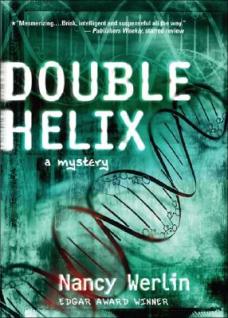
Module #9: Double Helix

Summary:
Eli and his father live in an uncomfortable, awkward, and at times tumultuous home. After obtaining a job with a famous biologist, Dr. Wyatt, Eli's estrangement from his father grows as a mystery decades old unravels. What is the relationship between Eli's terminally ill mother and Dr. Wyatt? Why does Eli's father hate the biologist so much? Who is the mysterious, beautiful girl staying with Dr. Wyatt and why does Eli feel so drawn to her? His relationships unfurl and deteriorate as Eli seeks the answers to his questions. When he learns the truth, will it change how Eli sees himself?
APA Reference:
Werlin, N. (2004). Double helix. New York, NY: Dial Books.
Professional Review:
DOUBLE HELIX Nancy Werlin. Dial, $15.99 (256p) ISBN 0-8037-2606-6
DOUBLE HELIX (Book) [Review of the book Double helix]. (2004). Publishers Weekly, 251(7), 173-174.
Impressions:
Nancy Werlin’s medical mystery weaves suspense and medical drama into a thought-provoking narrative. The main characters, Eli, Dr. Wyatt, and Eli’s father, are complimented by a cast of secondary female characters, the enigmatic Kayla and Eli’s girlfriend Viv. Werlin creates strong supporting female characters who display confidence, courage, and intelligence, helping to unweave the puzzle Wyatt presents. In Dr. Wyatt we see the epitome of egotism in medical research and blatant disregard for ethical issues, a warning that Werlin brings home to the readers. Even with a whispered warning regarding the implications of researching involving stem cells, embryos, and genetic engineering, the book itself does not come off as didactic or overly-preachy. Instead, the reader is left with questions regarding these issues and the thrill of a well-structured and evenly paced mystery.
Library Uses:This title is a terrific choice as a read aloud for Language Arts classes and Biology or other science classes as it allows teachers to build cross-curriculuar connections through literature. The library can support the exploration of medical ethics through text sets that include other science fiction and literary texts and nonfiction texts that address the scientific and ethical issues that surround genetic engineering and research. Additional novels may include Jodi Piccoult’s My Sister’s Keeper and Nancy Farmer’s House of the Scorpion.
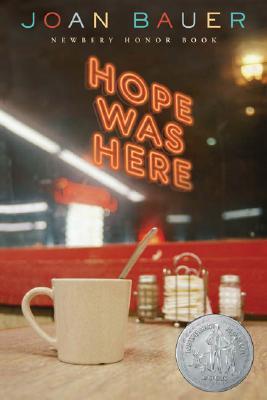
Module #7 Hope Was Here
Book Summary
Hope and her aunt arrive at a new Wisconsin town after leaving New York City to work as a waitress and head chef. She has become accustomed to leaving behind friends and moving from place to place, but this new town forces her to put down real root when the restaurant’s owner, GT, a leukemia survivor, decides to run against the town’s interim mayor in the next election. Hope joins the campaign believing in GT’s vision and passion for the small town and finds herself a permanent home with a full family.
APA Reference
Bauer, J. (2000). Hope was here. New York, NY: Puffin Books.
Impressions
Hope quickly became one of my favorite female characters. Bauer created a leading female teenage character who is honest, complex, faulted, and most importantly, hopeful. As realistic fiction, this book provides a refreshingly optomistic and gentle examination of some of the more serious issues that some YA realistic titles explore through much more dramatic means. Issues realting to cancer, racism, political corruption, and non-traditional families are treated with dignity and honest perspectives of the characters who are affected throughout the story. GT, although he knows how precarious his life is and how close to death he came, chooses to–despite his relapse–stand up for a cause and become the leader he feels his community needs. The slow-to-grow romance between Hope and short-order-cook Braverman develop with patience and sincerity throughout the course of the novel stands in contrast to the “brooding boy meets girl-next-door” love story that populates many YA books. The secondary cast of characters including the villainous corrupt mayor, Eli Millstone, and Hope’s absentee mother round out the diverse array of human relationships and motivations and stand in stark contrast to heroic GT and Addie, Hope’s maternal figure.
Professional Review
Hope Was Here
Fletcherspear, K. (2001). Hope Was Here (Book Review) [Review of the book Hope was here]. Book Report,19(5), 56.
Library Uses
NCTE 2012: Classical and Current: The Hybrid High School ReadingCommunity
Classical and Current: The Hybrid High School Reading Community
As a high school English teacher, my initial attempts at creating a thriving reading community were inspired by the type of reading community that I was most familiar with–the literature class. There seems to be a shared experience among literature majors across universities and colleges; the community is based on the study of a canonical text, reading assigned chapters, coming to the lecture to be “filled with knowledge” regarding the Meaning of the text from the expert (aka professor), and then qualifying, defending, or denying that meaning through critical analysis. For a literature student, there is nothing more exciting that to deconstruct a work, applying a critical lens, and then writing or talking about it in relation to Truth and Life.
For a high school student, there is nothing more tortuous than to come to class and have your (very naive) English teacher lecture to you for 45 minutes a day about what the boring book written by some dead white guy “means.” And this is where my journey to creating the conditions for a thriving reading community began.
It did not take me very long to realize that my carefully crafted reading guides, lecture notes, and essay tests were not helping me in my goals to facilitate a love of reading for my adolescent readers. While I pondered, explored, and experimented with ways to help my students construct meaning from their reading experiences with works such as Lord of the Flies and Oedipus Rex, my administration recognized a certain fervor and energy within me and bestowed upon me a very special assignment: the English repeat class. My second year of teaching I was “selected” to take the freshmen English I class that consisted of students who had failed the course the first time.
“It didn’t work for them the first time, Audrey, so do something different with them.” Different. What did I know that was different? Luckily, that summer, a friend introduced me to a “new” author, Walter Dean Myers and this book about a teenage boy on trial for murder. Since 95% of my students were boys and 75% of them were hispanic or black, I said, “hey, this is different” and managed to collect enough copies of Monster to spread around my classroom. After the first day, I realized that I had found the difference that makes the difference–young adult books that engage students with stories about protagonists who they can relate to.
My little class of repeaters eventually became my first taste of what a reading community can look like in a high school English class. Students were sharing books, talking about what they liked and didn’t like, writing in response to what they read, and making meaning through Literature study. Since then, I’ve heard many stories about how YA literature was first introduced to high school remedial or reluctant reader classes because they “can’t handle” real literature. At the time, I might have nodded in agreement. Today, however, I’ve come to realize that YA literature IS real literature and that with an appropriate balance and reader-response based practices, ALL adolescents not only can handle the canon, but can come to see it as a part of their reading lives and communities.
As my confidence in what I was doing with YA literature grew, I began to integrate the same practices into my on-level English classrooms. I brought YA books such as Laurie Halse Anderson’s Speak into my classroom to book talk and share and even took my classes to the library to check out books. Simply showing my students books did not ignite a love for reading, however. I decided that because reading was not a regular habit for my students–many reported having never finished a book for pleasure on their own– or they were just too busy to read on their own, I borrowed a practice from my experience as an elementary student: DEAR (Drop Everything and Read). I started incorporating DEAR into the first five minutes of every class as my “bell-warmer” but realized almost immediately, that five minutes was not enough time to engage in a book.
Before I could consider extending independent reading time every class period, I had to consider what I was ready to let go of. What practices was I clinging to out of familiarity or peer pressure that I knew weren’t really contributing to my students’ growth as readers and writers? I return to this question regularly to make room for the community to continue to thrive. First on the chopping block were ten assigned vocabulary words that we would define on Monday, write sentences with on Wednesday, and quiz on Friday. I upped our DEAR time to 15 minutes each day with a five minute reader response time and the shift in our values as a community was immediate.
A typical class period would begin with a book talk, trailer, or read aloud to introduce a new title to my class. We, ALL, would read for 15 minutes. Yes, I read with them. I did not take attendance, answer my emails, or grade papers. I settled myself in my director’s chair, set my timer (because I would often stop watching the time, losing myself in my book), and read with my students. At the end of the time, we all wrote in response to our reading. Some days I included a mini-lesson or think aloud about my book, but most days was open for students to respond as they needed. After DEAR, we would go on to our literature study or writing lesson.
Students were sharing books, asking for recommendations, borrowing from my collection or visiting the school and public library. But when DEAR was over, our community seemed to take a back seat to the Literature we had to “cover.” I began to wonder, “how can I help my students find the connections and “intertextuality” between the books they love to read and the traditional texts we study?
 Isn’t it amazing how the stars all seem to align at the same time? Images, culture, events, and your own burning questions start to take shape and have momentum. At the same time I wondered how to create bridges between my students’ reading experiences with YA and traditional titles, the Prius started to become popular. Everywhere I would see ads, hear commercials on the radio and T.V. The Prius seemed to populate streets and highways overnight. A hybrid vehicle: the best of the traditional model with the efficiency and innovation of the contemporary world.
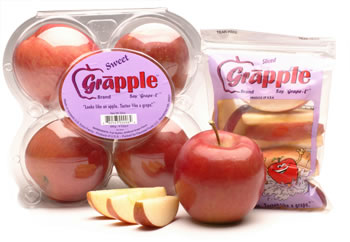
As the Prius gained in popularity, “hybridism” seemed to be infiltrating mainstream life. One day while perusing my grocery store’s apple collection I came across the “grapple.” The grapple is a grape-apple! How ingenious (and yummy).
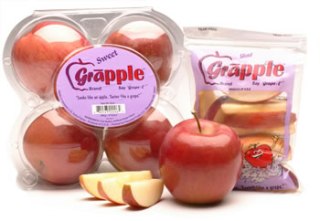 And then I realized, my classroom is a grapple; a hybrid high school English classroom integrates the contemporary stories, texts, and reading experiences with constructive literature study, allowing for a reading community to take root, grow, and explore life’s big questions.
I’ve thought a lot about the “how-to” part of creating these communities. There are three real practices or “simple rules” that are non-negotiable for a healthy high school reading community. For each of the following practices, I’ve included tools, resources, and samples that I have created with and for my students.

Three practices that foster high school reading communities:
1) Let your students get to know you as a reader– read in front of them, to them, for them, and with them. Seek out and join a reading community–either in person or online.
Check out these sites and blogs to follow:
Goodreads.com
Shelfari.com
Nerdybookclub.wordpress.com
yabooklove.com
teachmentortexts.com
2) Support their exposure to young adult literature with book talks, trailers, and lists that draw a thematic connection to literature.
3) Invite them to explore difficult themes, contexts, and situations in young adult literature alongside classical literature with peers through literature circles. Bring in contemporary authors as writing exemplars and mentor texts to engage students in young adult and adult literature while empowering them as young writers.
VoiceThread book talk sharing titles that explore questions regarding war and its impact on the individual to accompany Tim O’Brien’s The Things They Carried.
(This blog post is a re-telling of the round-table presentation for The Nerdy Book Club panel at NCTE, 2012–special thanks to all of the amazing Nerdy members I met and connected with in Vegas!)
- ← Previous
- 1
- …
- 3
- 4
- 5
- Next →
 (Re)Inventing the Librarian