Book Trailer Thursday: Shatter Me

Posted on

Fans of Hunger Games, Divergent, and Matched might find a new heroine to emulate.  Meet Juliette, a lonely, powerful, lethal young woman who is desperate to touch not be touched.

Shatter Me by Tahereh Mafi

available at The Library @ the Ridge!

Remind101: A Safe Communication Tool for Students, Parents, and Teachers

Posted on Updated on

 Technology Tuesday #2

Yesterday, I was at my parents’ house for our Labor Day smorgasbor. My niece Kylie, a high school senior, received a message on her phone during dinner (not an uncommon phenomenon in our family).  Our conversation continued as normal while she flipped to her text message screen.  “Oh, good,” she said, “I’m glad she reminded us.”  Immediately, my ears tuned-in with the topic of today’s blog fresh on my mind.  Something told me I was witnessing an example of the exact tool I hoped to share with you for this installment of Tech Tuesday.  I decided to be nosey and ask her about the message.  She turned the screen my direction and sure enough, I was right!  From an unidentified number, the message read, “Don’t forget to bring your ASL II textbook to class tomorrow.”  


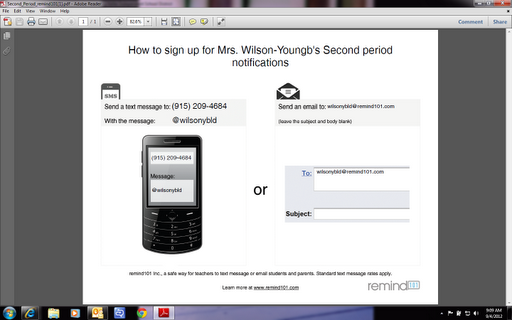
Signing up is free and easy!


Kylie was eager to tell me all about the ways that her ASL teacher was using this new website, remind101.com.  The site is a free tool for educators that allows them to send messages via text to their students through an private number.  Privacy is retained on both ends of the message;  the student does not have access to the teacher’s private phone number, nor does the teacher know the students!  Cha-ching! In addition to texts, students and parents can receive messages through email. I asked her what the class thought of the tool, and she shared that her classmates loved it and wished that all their teachers used it. 


Create classes with custom tags.
 students enroll themselves through text or email. 
Select which classes will receive the message.
You can even tell it when to send the message
 if you want to schedule them in advance.


I hear a lot of rumbling from colleagues about communication with students.  Often times, teachers are “encouraged” to use district-created sites that are burdensome and difficult to maintain to communicate with students and teachers.  While ideally, all teacher pages would be networked through the same service, contain the same features, and tools, these sites can be just as difficult for students and parents to access, involving multiple “clicks” and browsing to locate an individual teacher’s page.  The reality is that teachers want  to get information to their students and students want to be informed.  Distributing your pesonal phone number to students, although convenient, may not always be the safest way to maintain communication.  Many districts have created privacy policies that prohibit teachers from contacting students through personal numbers or Facebook pages, citing federal privacy laws. (See more about Texas’ student privacy laws and FERPA
Students feel connected to their teacher when they recieve updates, reminders, and announcements through text or email.  The teacher is “speaking their language.”  For educators, remind101 allows them to distribute information quickly and safely while complying with privacy laws and policies. 
With Open House right around the corner, you might consider setting up your classes on remind101 and invite parents to subscribe.  The website provides .PDF handouts with your customized information that can be distributed to parents and students.  There is very little work for the teacher when creating classes as students and teachers subscribe themselves to a class using a customized number and code.   
When communication is clear, concise, and consistent, students are free to engage in learning rather than becoming bogged in the amount of information and tasks distributed to them over the course of a school day. Parents, too, appreciate the free-flow of information as stakeholders in their child’s education. Remind101 is one of many free services that helps students become task-managers and supports their success.
A video tutorial is available on Vimeo for Remind101. 
Curious about other web-based tools that can support communication and even be integrated into instruction?  Check out Twitter!
Quentin Donellan’s Blog about using Twitter as an instructional tool.


Module 2: Freight Train

Posted on Updated on

Book Summary: A colorful train in red, orange, yellow, green, blue, and purple speeds across a simple track.  Simple, block letters describe  the types of car on the train through repeated sight words and short sentences.

APA Reference: Crews, D. (1978).  Freight train.  New York, NY:  Greenwillow Books. 
Impressions:  From the first sentence on a nearly blank white page, I was captivated, “A train runs across this track.”  With each page turn bold, vivid colors and text capture the eye and imagination Although very simple and two dimensional, the illustrations still manage to convey the motion and detail of the various cars.  As the train begins to move, the colors blur to create a perfect spectrum of color.  Simple phrases and verbs build early readers’ confidence with sight words while maintaining the action and speed of the train.

Professional Review:  From School Library Journal (1978) “Happily, Crews did a fine job with Freight Train’s illustrations which aptly convey the excitement of a train rushing by in a blur of color” (p. 131).

DeVinney, G., & Gerhardt, L. N. (1978). Freight train/rain (Review of the book Freight train). School Library Journal25(2), 131.

Library Uses: This text would make an engaging story time text for early readers.  Children could re-enact the story by using felt cut-outs of the train carts, tunnel, track, etc. and the teacher can help to label the motion of the train using the action verbs from the story.  

Module 1: On the Night You Were Born

Posted on Updated on

Book Summary:  Tillman celebrates a newborn’s unique contributions to the world from the magical sound of a name to “wiggly, wonderful toes.”  Across the earth, animals and nature join in the celebration;  polar bears dance, the wind whispers, and even the moon stays up extra late.  

APA Reference:  Tillman, N. (2005) On the night you were born. New York, NY:  Feiwel and Friends. 


Impressions:  The lilting, lyrical quality of this book recreates the comforting, rocking motion of a lullabye and leaves the adult reader with the desire to curl up in a rocking chair with an infant in his or her arms.  Much like a lullaby, the images and words combine to create a peaceful sense of night with dreamlike illustrations that incorporate music notes symbolic of the night wind.  The pages where text is limited to a phrase or short sentence such as, “Over the ocean….” “And through the trees…”  invite very young children to explore the accompanying illustrations focusing on one idea at a time.  Towards the end of the book beginning with “So whenever you doubt…”  children may become restless waiting for a page turn as the text lengthens.  Because of the sentimentality, abstract quality to the illustrations, and lengthy poetic pages, adults might favor this book over their young children.  It will, no doubt, still help to create the bond between parent and child during a shared reading time. 

Professional Review:  From School Library Journal (2007), “The dark blue night skies make a beautiful and dramatic setting for this special night.  The painterly art and poetic quality of the text make this an attractive book.  Parents and grandparents are most likely to appreciate it, but they will undoubtedly want to share it with a child.”  

Janssen, C. (2007). On the night you were born (Review of the book On the night you were born)School Library Journal53(3), 186-187.


Library Uses:  
This picture book would make an excellent mentor text for students to imitate poetry, particularly rhyming couplets.  By following the basic form of the text as a poem, students could create a “On the Night I was Born” book to introduce themselves through unique facts about their own birthdays.  Integrate research by having students find events that took place on the day they were born throughout history. 

Myth #2–I have to Know a Lot About YA Literature

Posted on

Let’s face it; we can’t all be Book Whisperers (nod to esteemed colleague and friend Donalyn Miller).  The life of an English teacher usually involves hours bent over essays or perusing the same classical text we’ve taught for the umpteenth time.  When am I supposed to have time to read something for fun let alone books for teens?    

I don’t expect every high school teacher to be a card carrying member of the American Library Association, dedicated to each new issue of School Library Journal.  When I first introduced independent reading or Sustained Silent Reading (SSR) into my classroom routine, I had a grand total of 15 books sitting on the shelf,  five of which were in the Harry Potter series.  
It doesn’t matter where you start as long as you start somewhere.  I don’t care if it’s The Hunger Games or even Twilight.  If your students start to see you as a reader, then they will begin to see that reading has value.

You may not know much about YA when you begin, but by the end of the first month you will have more book recommendations from students, blogs, and your librarian then you know where to make your reading piles.  Until then, here are a few sites to feed your new-found literary habit:

1)  Goodreads.com–a social site that allows users to build shelves (to-be read, reading, read) and organize their reading lists, browe new titles, connect with readers and authors, and rate and review their books. 
2) Teachmentortexts.com–a blog by two teachers who are devoted to sharing books they read that promote all areas of literacy.  The books are reviewed and can be filtered by literacy strand that the bloggers see an opportunity for classroom use as a mentor text.  Using current, exciting young adult literature to teach literacy!  How novel!
3)  YouTube–A simple search for “young adult book trailers” will produce gobs and gobs of professional and fan-made book trailers.  Bre sure to preview trailers before showing them to kids as the quality and content may not always be suitable for classroom use.
4)  Barnes and Noble/ Amazon–both bookseller’s sites have a section for young adult literature, recommendations, reviews, and lists.  Warning:  do not auto-fill your credit card info before browsing as purchasing all the wonderful titles you find becomes very addicting and “just one more book” becomes two boxes full of hardbacks delivered by your local FedEx truck!
5)  Young Adult Library Services Association (YALSA)–www.ala.org/yalsa  A division of ALA devoted to young adult teachers, librarians, and readers, this organization provides several useful top ten lists compiled by teens themselves.
6)  Figment.com–Here we have another social media site where users can be readers and writers.  There are forums for writers to publish their own work on the site and to browse other user’s writings.  On the reading side, Figment posts latest book news, trailers, author interviews, and reviews. 

A thriving reading community is dependent upon authentic reading role-models.  As the facilitator of the community, the time that you invest in reading in front of your kids and talking about what you are raeding, the more gains you will see in their level of interest. 
I may never be the kind of reader I imagine in my head; I read much more slowly than some might imagine.  Unlike my colleagues, I can’t race through a 400-page novel in one Sunday afternoon.  I don’t know if I’ll ever read ALL of the Newbery books or complete a hundred book challenge.  But, I do know that if I never try, then not only will I never be that reader, but neither will my students. 

How did you make that reading leap?  What book re-invented you as a reader?

Happy reading!

Audrey

Independent Reading Myth #1–Today’s Teens Don’t Read

Posted on

There is a heavily engraved image of today’s youth, earbuds as an extension of their actual bodies, thumbs glued to their smart phones.  No where do we see books in their hands.  Today’s youth is uninterested in the simple pleasure of reading.  He would rather be figuring out how to advance to the next level of Halo XXIII or updating his Facebook status about what he ate for dinner.  Not only is he uninterested in the simplicity of the printed word, he doesn’t have the attention span for it.

On the contrary, according to the NEA’s 2008 report, Reading on the Rise, young adults represent the fastest growing subpopulation that have significantly increased their reading habits.  Literary reading as a whole has reversed its downward spiral over the past two decades, increasing by 7% between 2002-2008.  Young adults, who on the last survey showed the steepest decline in 2002 have grown by 9 points, rising fastest out of the whole survey population.  In 2008, 51% of young adults reported that they read novels, short stories, poems, and plays either in print or online. 

The reality is that today’s teens are reading and reading in droves!  Thanks to the popularity of recent blockbuster adaptations of YA series, these exciting and relevant stories are coming into mainstream.  In fact, there is even a movement to include a book award in Fox’s Teen Choice Awards.  YA author Jennifer Donnelly has been an advocate of this movement from the beginning.  I can see it now–Veronica Roth’s Divergent up there next to Lil Wayne and Lady Gaga.

Teens are flocking to stories with strong heroines and nerdy book smart boys.  They are stalking authors like John Greene and Stephanie Meyer with more gusto than any film or radio star.

How do I know this?  Because I talk to them about it. I ask them what they’ve read or who their favorite author is.  I ask them about how they choose books and who among their friends shares the same taste in books as they do.  I ask them what makes a book great and then dangle carrots of curiousity in front of their noses, hoping to lead to discover yet another awesome YA novel.

Then why can’t we seem them doing it? Many of them are reading covertly.  Sadly, in their daily lives reading may not be valued.  Perhaps none of their teachers talk to them about reading for pleasure or even give them time to read something of their choice in class.  Devastating, I know.  Or for some, they are reading in plain view, right under your nose.  E-readers, apps, and digital media have connected a whole generation of “digital natives” to a new look at literary life.  They look like they are scrolling through Facebook?  Nope, they’re flipping as fast as they can through The Summer I Turned Pretty.  Texting a friend?  Nope, they are updating their goodreads shelves and writing reviews of their favorites.
Perhaps it’s not teens whose behaviors and perceptions need a major shift.  Perhaps it’s how we perceive readers themselves and what they read that could use a little adjustment instead.  

Like to think about this a little more?  Check out some of these resources:
“The Young Adult Voice in Research About Young Adults” (YALSA)
“The Kids Books are Alright” (NY Times)
“American Reading Habits Studied”

Please share any resources you may have to contribute to this conversation!

Happy reading 🙂

Audrey

Book Review: A Monster Calls

Posted on

I have a deeply routed fear.  It’s been there now, deep in my psyche and weighing on my heart for about a year.  When I least expect, it creeps up like a serpnt from the base of my big toe and wraps itself around my heart.  Air rushes from my lungs and tears fill my eyes.
I’ve become a magnet.  A magnet to stories, blogs, novels, anything regarding parents and children, especially mothers and their sons.  It feels like there’s been an explosion on Facebook of blogs reposted by friends of families who have experienced the loss of a child or a parent.  Their stories lead me to my knees, humbled in the face of my fear.

My fear is two-fold:
1) That I will lose my son.
2) That my son will lose me.
The truth of the matter is- unless a freak and tragic accident takes us both at the same time (God forbid)- one of us will lose the other in our lifetime.  And this is the thought that wakes me up at night and that draws me to stories of loss.

Today, a friend reposted a blog of a mother whose toddler son died from a heart arhythmia during his regular nap.

A couple of months ago, a friend reposted a blog of a husband and father of two young boys, whose wife died very suddenly last fall.

 A Monster Calls by Patrick Ness–Official Book Trailer

I read their stories and beg…whoever is out there to beg…that it not be me and my son.
Recently, I read Patrick Ness’s A Monster Calls.  This superb, lovely, painful little book has haunted me ever since.  As the main character’s mother is dying from cancer, he struggles to satiate the monster who calls on him every night at the same time.  At a certain point in the book, the boy steps into the monster and becomes him, wreaking havoc and destruction on his enemies.  And yet, this is not the monster that he fears the most.  What he fears the most is fear itself.  Fear that what he truly wants is for his mother to die to end her pain.  Fear that his mother will die.  Fear that, when the time comes, he cannot let her go.

At night, when the shadows reach across the bed from the tree outside my window, I can feel the yew’s prickly branches and its spicy, woody scent fills my nose. 
I know one day that my fear will be realized.  Until then, I’ll keep reading.  I read to find solace in the inexplicable connection grief can weave between strangers.  I read to unearth glints of understanding and patterns to try to ratioanlize why a mother would ever have to lose a child or a child ever to have to live without its mother.  But I know that just as this Winter will turn to Spring,  there is life on the otherside.  It’s a life I never want to understand. 

But until then, I’ll read.

My fear does bring me joy.  It’s started to become my companion during the day, especially when a toddler tantrum raises feelings of frustration.  My fear whispers, “someday, these moments will be memories.  Someday your arms will ache to wrap themselves around him and he will not be there.  Someday he will long to hear you say his name and whisper, “I love you,” but you will not be there.”  And so, in those moments and every moment in between I will say his name and whisper as I wrap my arms around him, “I love you. I love you.  I love you.”

Urban YA Top Ten

Posted on

Urban YA Top Ten List

In preparation for compiling a top ten list, I asked a good friend of mine if I could raid her English department library to brush up on my urban YA lit. As we poured over titles in a colleague’s classroom library, she asked, “How are you defining ‘urban YA?'”

I paused. “Well, YA titles with urban settings I guess?” (Dur).

I started to rattle off a number of what I felt to be obvious criteria: issues that deal with street violence, gangs, drugs, racial conflict, teen pregnancy, homeless teens, obscene language….and I stopped myself. Here I was, attempting to define a literary genre with every cliché that so many of my students are slapped with every day. I wouldn’t limit my understanding of my own students with these labels; how incredibly unfair of me to do it to the books they love!

Not only are these selections never sitting on the shelf collecting dust, they represent the realities of so many of our students whose stories traditionally have not been included in the literature we teach (or the titles with which we stock our classroom libraries). As a reading teacher, the following titles are “friends,” who I would gladly throw myself on my proverbial sword for if challenged, because the truth of the matter is these books could be challenged. Easily. The urban landscapes painted in these works are not only vivid and real, but their truth and complexity draws students into them, not the risqué four-letter words and adult scenes that keep pages turning and librarians cringing. The plots, while containing very adult themes, contain rays of hope amidst the stark realism of life on the streets for the protagonists who exhibit tremendous depth.

Lastly, I most appreciate these books for the sense of personal and reading identity they inspire in their reader. For many, these books are their first experiences with the sheer joy of reading. In these books, students recognize themselves, perhaps for the first time in their reading lives.


Top Ten Urban YA List (in alphabetical order):

Bronx

Bronx Masquerade by Nikki Grimes

“When Wesley Boone writes a poem for his high school English class and reads it aloud, poetry-slam-style, he kicks off a revolution. Soon his classmates are clamoring to have weekly poetry sessions. One by one, eighteen students take on the risky challenge of self-revelation…” (goodreads.com).

The power of the spoken word–of poetry to bring down walls and build bridges. The experience of reading Bronx Masquerade aloud with my students not only helped to shape their reading identities as they could relate to the myriad of characters who lend their voices, but it also allowed us to explore our own stories through poetry. This title is one where students feel compelled to write in response to and in imitation of the student voices they recognize so well.

First_part

The First Part Last by Angela Johnson

“Bobby’s a classic urban teenager. He’s restless. He’s impulsive. But the thing that makes him different is this: He’s going to be a father. His girlfriend, Nia, is pregnant, and their lives are about to change forever…” (goodreads.com)

This is one book that I brought to my classroom after finding it tucked away in the corner of a YA stack in a local used books store. It came to class on a Monday, I book-talked it in each class, and on Tuesday morning it was gone, never to be seen again. But, I would hear about it in passing from my students who shared it among themselves, and then from their friends and friends of friends in the hallway. It is such a gentle book. I don’t know how else to describe it other than that the tenderness and sincerity of the narrator, Bobby, is like a feather lofting through a breeze. And so does the book, float from reader to reader. Even my most hardened non-readers find something familiar in Bobby’s struggle to be a single, teenage father and the heart-breaking loss he keeps tucked away
Homeboyz

Homeboyz

by Alan Sitomer

“When Teddy Anderson’s little sister Tina is gunned down randomly in a drive-by shooting, the gangstas who rule the streets in the Anderson family’s rapidly deteriorating neighborhood dismiss the incident as just another case of RP, RT-wrong place, wrong time. According to gangsta logic, Tina doesn’t even count as a statistic …” (goodreads.com).

In readers’ notebooks, I often find pages upon pages of students’ thoughts and reactions to this novel. Many of them feel they are Teddy. Empathy is hard to come by in many teens; Sitomer’s skill at painting characters who devolve truthfully through the course of the story enables the teen reader to put himself in another’s shoes.

44184

Monster by Walter Dean Meyers

“Sometimes I feel like I have walked into the middle of a movie. Maybe I can make my own movie. The film will be the story of my life. No, not my life, but of this experience. I’ll call it what the lady who is the prosecutor called me. MONSTER” (goodreads.com).

Written as a screenplay, Monster is quickly devoured by any reader who opens to the first page of scrolling, Star Wars-esque credits. For some, however, reading a screenplay can be every bit as challenging as a full-length novel. But, once they embrace the form and listen as Steve stands behind and in front of the camera to try to process what has happened to him they are hooked to the end. Many readers feel compelled by the injustice as Myers masterfully paints the portrait of “the-boy-next-door” who made one mistake and is exposed to the harsh consequences of youth.

231804

The Outsiders by S.E. Hinton

“Written over forty years ago, S. E. Hinton’s classic story of the struggle between the Socs and the Greasers remains as powerful today as it was the day it was written, and it is taught in schools nationwide…” (goodreads.com)

Come on. Really? How could I not include the grand-daddy of all urban YA Lit?! I toyed with it, of course. But in the end, this timeless story still appeals to a wide array of readers in my high school classroom. Many students first encountered the book in middle school. In fact, in their reading biographies they write for me in the beginning of the year, The Outsiders, is the #1 book mentioned that they finished reading! Ever! With that kind of staying power, how could it not be on any top ten YA llist. Ponyboy is a reminder of the ever-present “socs” and “greasers” in the microcosm of high school.

4268157

Perfect Chemistry by Simone Elkeles

“When Brittany Ellis walks into chemistry class on the first day of senior year, she has no clue that her carefully created “perfect” life is about to unravel before her eyes. She’s forced to be lab partners with Alex Fuentes, a gang member from the other side of town, and he is about to threaten everything she’s worked so hard for—her flawless reputation, her relationship with her boyfriend, and the secret that her home life is anything but perfect…” (goodreads.com).

Yes, it’s true; this is a re-told Romeo and Juliet…sort of. Perfect Chemistry is a prime example of the urban novel that crosses over from a landscape of privilege to challenge (Thomas, 2011). Even though the story and characters might border on cliché, the universal appeal and high-drama keep this book from collecting any dust on the shelf. I always find it interesting to watch the conversations between unlikely students that this novel sparks. Girls and boys alike of all backgrounds line up to read it and its subsequent sequels. They dub themselves the “Alex and Brittany Fan Club.””


51dgeia3idl


The Rose that Grew From Concrete by Tupac Shakur

“This collection of more than 100 poems that honestly and artfully confront topics ranging from poverty and motherhood to Van Gogh and Mandela is presented in Tupac Shakur’s own handwriting on one side of the page, with a typed version on the opposite side” (goodreads.com).
I happened upon this tiny book by luck in the bargain bin at Borders Bookstore. I immediately saw its potential to engage students in poetry, but I couldn’t have imagined the fire it would ignite in my students. Not only were they astonished that they were allowed to read Tupac, they were thrilled to finally understand what I meant when I talked about choice–I really meant they had the freedom to choose books of their own interest. His collection of poetry became a gateway for students who would go on to Tupac’s biography, and then Jacquelin Woodson’s Tupac and D Foster, and into the worlds of Sitomer, Myers, and Drake.

Tyrell

Tyrell by Coe Booth

…”Tyrell is a young, African American teen who can’t get a break. He’s living (for now) with his spaced-out mother and little brother in a homeless shelter. His father’s in jail. …. Tyrell feels he needs to score some money to make things better. Will he end up following in his father’s footsteps?” (goodreads.com).

Honestly, Tyrell had me blushing at times when I read it. I wondered how I could bring it into my class library without drawing too much attention. Luckily, my students have learned the value of discretion, especially when they find a book they love. What I love about Tyrell is that he is a deeply sensitive, complex, conflicted teenage boy…aren’t they all? The age-old father/ son conflict plays like a soundtrack behind the reading of this novel, even though the father character never makes an actual appearance. We see all kinds of women as well, who are brought to life through a sixteen-year old’s eyes. Despite the dire circumstances and odds, Tyrell inspires hope.

751635

The Skin I’m in by Sharon Flake
“Maleeka suffers every day from the taunts of the other kids in her class. If they’re not getting at her about her homemade clothes or her good grades, it’s about her dark, black skin.

When a new teacher, whose face is blotched with a startling white patch, starts at their school, Maleeka can see there is bound to be trouble for her too. But the new teacher’s attitude surprises Maleeka. Miss Saunders loves the skin she’s in. Can Maleeka learn to do the same?” (goodreads.com).

How I love this book! I wish I could put this in the hands of every adolescent teenage girl, no matter their ethnicity, race, nationality, geography, or belief. I often need a box of Kleenex close buy as I read young girls’ responses to Maleeka’s struggle to accept and LOVE herself as she is. I swear, I think they walk a little taller by the end of this book.

378982

Upstate by Kalisha Buckhanan

“Baby, the first thing I need to know from you is do you believe I killed my father?”

“So begins Upstate, a powerful story told through letters between seventeen-year-old Antonio and his sixteen-year-old girlfriend, Natasha, set in the 1990’s in New York. Antonio and Natasha’s world is turned upside down, and their young love is put to the test, when Antonio finds himself in jail, accused of a shocking crime…” (goodreads.com).

(Confession) I haven’t actually finished Upstate. I don’t remember how it came to be in my library collection. I know I picked it up a few times and put it down, feeling that it was too trite, superficial, and explicit for my taste. But, out of desperation to get a certain reluctant teen reading, I placed it in her hands, and it spread like wildfire. I have faith in this book after reading about its characters in many response notebooks. My current copy has been “permanently borrowed,” but I’m not upset about it; I know it’s out there, floating from reader to reader inspiring hope.

Finally, I’d like to end with a poem that represents the Urban YA genre to me and its place in my classroom library:

Did you hear about the rose that grew
from a crack in the concrete?
Proving nature’s law is wrong it
learned to walk without having feet.
Funny it seems, but by keeping its dreams,
it learned to breathe fresh air.
Long live the rose that grew from concrete
when no one else ever cared.

~Tupac Shakur, The Rose that Grew from Concrete

Reference:

Thomas, Ebony Elizabeth, “Landscapes of City and Self: Place and Identity in Urban Young Adult Literature” (2011). Faculty Publications. Paper 3. http://digitalcommons.wayne.edu/coe_ted/3

Myths Surrounding Independent Reading in High School

Posted on Updated on

Often, when I’m out visiting with teachers and consulting, I make the positive presupposition (Thank you Kathryn Kee! ) that teachers are having their students read a text of their choice everyday.  I might make such comments as, “This would be an easy strategy to integrate into students’ independent response time during their free reading time in class.”  Or, “When you book-talk to your students, you might frame it in terms of genre…”

Sometimes I receive polite head-nods and sometimes I receive eye-rolling.  Independent reading time in a high school English classroom?  (And unicorns poop rainbows.)
Every now and then, I’m greatful for the honest and inquisitive participant who timidly raises her hand to ask, “What exactly do you mean by ‘independent reading’?”  She is usually within her first 5 years of teaching,  graduated from a stellar English literature/ composition program, and is the dark horse of the English department who spends her time reading things like  English Journal or following Jim Burke on Twitter.

When these gems come my way, I leap at the opportunity to unravel some perpetuative myths that exist in high school English departments and their most faithful faculty regarding independent reading.  These conversations allow me to dig down to my most fervent beliefs about reading communities and often do challenge some of those beliefs.  But, by the end of our conversation, whereas we may not still agree with one another, both the participant and myself have expanded our views just a little bit broader. 

And so, here they are!  The top 5 most common myths surrounding independent reading in high school: 
Myth #1–Today’s teenagers don’t read.
Myth #2–I have to know a lot about YA literature.
Myth #3–Students won’t read in class if I give them time.
Myth #4–It’ll mean more time spent on grading poster and book reports or messing with those leveled reading programs.
Myth #5–I don’t have the time.  We have all this literature we have to “cover.”

Boiling down all of the– honestly– valid obstacles to independent reading I have encountered myself and heard from colleagues to these five things is probably oversimplifying the issue.  If I’ve learned anything about problem solving as an educator, it’s that I need to start with what seems simple first.  Then, as I work my way through one problem at a time, the larger obstacle doesn’t feel quite so overwhelming. 

As a novice teacher, the five statements above floated above my head as I began to dig more into the possibility I knew was there for amazing reading experiences for myself and my students.  Please understand, I am not trying to be-little anyone’s experience or perspective.  The following “myths” I’ll offer as a series of posts echo my deepest, darkest, and most powerful experiences along my own journey. 

More importanlty than de-bunking these “myths,”  I hope to provide a snippet of success here and there and resources that I rely on to create a transformative, empowering reading community. 

Happy reading!

Myth #1

Myth #2

Myth #3

Myth #4

Myth #5

Book Review: Insurgent

Posted on

Originally written for nerdybookclub.wordpress.com on May 23rd, 2012
Insurgent by Veronica Roth
One choice can transform you—or it can destroy you. But every choice has consequences, and as unrest surges in the factions all around her, Tris Prior must continue trying to save those she loves—and herself—while grappling with haunting questions of grief and forgiveness, identity and loyalty, politics and love (Goodreads.com).

What would you choose if you only had one choice:  bravery, honesty, selflessness, knowledge, or peace?  If all of your actions, your relationships, your being were to be determined by only one of these traits, what would be your choice?? 

The futuristic society of Veronica Roth’s Divergent has determined that the one way to combat the darkness of human nature is to divide itself into five factions, each faction devoted to one of the pre-determined necessary human qualities. Sixteen-year old Beatrice (Tris) Prior’s journey begins with a choosing ceremony.  (Sound familiar?) Unlike her peers, Tris has a much broader spectrum of who she could become.  Her choice takes her to a foreign world on the other side of the tracks in downtown Chicago where there’s a fine line between bravery and bullying, courage and cowardice. 
Suddenly, she finds herself at the center of a social and political civil war.  As Divergent closes we find ourselves speeding away on a train through the heart of Chicago seeking sanctuary from those who once stood by Tris, protected her,  glowing in the warmth of her new-found relationship with fellow Dauntless, Four,  and  suspended as  she yearns for redemption from her overwhelming guilt.
Insurgent is a remarkable exploration of human nature and motivation.  It’s an experiment in societal reform.  When society has so divided itself that it can no longer function as a cohesive organism what happens to those who have been abused and their abusers?     As the consequences of her fatal choice in Divergent fall like dominoes, faster than she can process, her dearest relationships are endangered;  her self-searching and determination to understand the truth about who she is at the foreground of a crumbling societey. 
True to many other “seconds” in a series, I found myself spending a painful amount of time teetering at the edge of our hero’s abyss.   In the first installation, we walk with Beatrice through the threshold (Divergent fans recall Tris catapulting herself from a rooftop) as she finds a loyal band of followers and undergoes a series of tests and trials as part of her initiation.  Once her quest is determined in Insurgent, other figures emerge as part of the dystopian landscape: the evil figure with the untimely good heart, the temptress, even death and rebirth.  As her plunge into the abyss drawers nearer, she must go deeper and deeper into her most fearsome landscape– her own soul– in order to proceed with her journey of self-discovery.
It is impossible to ignore the similarities between Tris Prior, Katniss Everdeen, Harry Potter, Todd Hewitt, Cassia Reyes and countless other YA sci-fi/ fantasy heroes, teens teetering at the edge of their own awakening to their true powers.  Every one of their societies is fighting to analyze, sort, and label who they will become.  The societies and settings, too, bare familiarities leading me to believe that Gale or Katniss will suddenly appear, running alongside the train with Four and the other Dauntless.  I hear Manchee’s searching “Todd?” from under some discarded street rubble.  At any moment, I expect Hermione to pop out of the Erudite crowd, toting a long lost volume that holds the key to what really lies outside of the fence. 
And so, as I sprinted through the final chapter and the shadows on the wall were revealed to me as they are revealed during the jaw-dropping finale, I couldn’t help but wonder …Why are we so drawn to adolescent heroes who are standing on a precipice, waiting and daring to take such a leap, whether it be bravery or curiosity that compels them?
 There is no denying the sudden rise in popularity of dystopian literature.  A recent Goodreads blog examined the growing trend in popularity of dystopian novels and described its over-arching themes over the last 50 years.  The blogger labels this latest explosion (The Hunger Games, Matched, Diverent) as “Romance” Dystopian and sites such inspirations as 9/11, War on Terrorism, and the prevalence of pop culture.  Tough heroines and anti-conformity drive these stories. 
After reading Divergent and now Insurgent, I am taken back to an Erudite’s explanation,
“Insurgent,” he says.  “Noun.  A person who acts in opposition to the established authority, who is not necessarily regarded as a belligerent. “ 
Do I hear anti-conformity?  Oh , yes.  But I think it extends beyond being radical, to being purposeful.  In a futuristic society where every member knows his or her purpose as it is handed down to him or her, where does that leave free-will?  As a constructivist, this resonates with me.  As information is funneled into our teens (as it so often is at many bytes per minute), they are persistently bombarded with labels, categories, and profiles, what choices then are left to them to determine what their truth is? 
Are we–all of us as educators, librarians, readers–not all insurgent, seeking truth for ourselves and then deciding how we will assimilate that truth into who we are and what motivates us?
Are teens devouring dystopian literature for their love triangles and star-crossed lovers?  Yes, probably.  But, are they also entering a landscape of their own fears, beliefs, doubts, and dreams in order to choose what they will take with them as they emerge from their own abyss and cross the impending threshold into adulthood?  Absolutely!