It’s Monday! What are you reading? 1/14/13
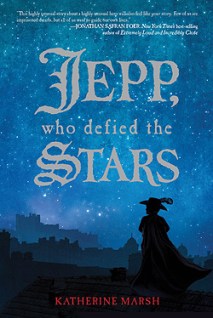 Jepp, Who Defied the Stars by Katherine Marsh
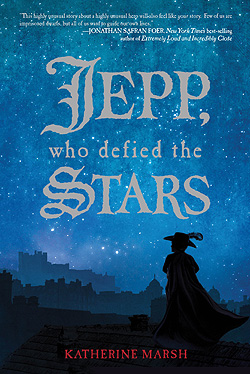
Fate: Is it written in the stars from the moment we are born? Or is it a bendable thing that we can shape with our own hands? Jepp of Astraveld needs to know. He left his countryside home on the empty promise of a stranger, only to become a captive in a luxurious prison: Coudenberg Palace, the royal court of the Spanish Infanta. Nobody warned Jepp that as a court dwarf, daily injustices would become his seemingly unshakable fate. If the humiliations were his alone, perhaps he could endure them; but it breaks Jepp’s heart to see his friend Lia suffer. After Jepp and Lia attempt a daring escape from the palace, Jepp is imprisoned again, alone in a cage. Now, spirited across Europe in a kidnapper’s carriage, Jepp fears where his unfortunate stars may lead him. But he can’t even begin to imagine the brilliant and eccentric new master–a man devoted to uncovering the secrets of the stars–who awaits him. Or the girl who will help him mend his heart and unearth the long-buried secrets of his past. Masterfully written, grippingly paced, and inspired by real histori-cal characters, “Jepp, Who Defied the Stars “is the tale of an extraordinary hero and his inspiring quest to become the master of his own destiny. ” ~Goodreads.com
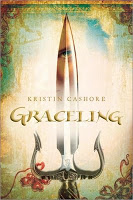
Graceling by Kristin Cashore
 His eyes, Katsa had never seen such eyes. One was silver, and the other, gold. They glowed in his sun-darkened face, uneven, and strange. She was surprised that they hadn’t shone in the darkness of their first meeting. They didn’t seem human….
Then he raised his eyebrows a hair, and his mouth shifted into the hint of a smirk. He nodded at her, just barely, and it released her from her spell.
Cocky, she thought. Cocky and arrogant, this one, and that was all there was to make of him. Whatever game he was playing, if he expected her to join him he would be disappointed.
In a world where people born with an extreme skill – called a Grace – are feared and exploited, Katsa carries the burden of the skill even shedespises: the Grace of killing. She lives under the command of her uncle Randa, King of the Middluns, and is expected to execute his dirty work, punishing and torturing anyone who displeases him.
When she first meets Prince Po, who is Graced with combat skills, Katsa has no hint of how her life is about to change.
She never expects to become Po’s friend.
She never expects to learn a new truth about her own Grace – or about a terrible secret that lies hidden far away…a secret that could destroy all seven kingdoms with words alone. ~Goodreads.com
The Fault in Our Stars by John Green
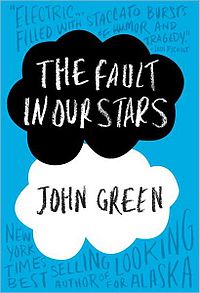 Diagnosed with Stage IV thyroid cancer at 13, Hazel was prepared to die until, at 14, a medical miracle shrunk the tumours in her lungs… for now.
Two years post-miracle, sixteen-year-old Hazel is post-everything else, too; post-high school, post-friends and post-normalcy. And even though she could live for a long time (whatever that means), Hazel lives tethered to an oxygen tank, the tumours tenuously kept at bay with a constant chemical assault.
Enter Augustus Waters. A match made at cancer kid support group, Augustus is gorgeous, in remission, and shockingly to her, interested in Hazel. Being with Augustus is both an unexpected destination and a long-needed journey, pushing Hazel to re-examine how sickness and health, life and death, will define her and the legacy that everyone leaves behind. ~Goodreads.com
Adventures in iPads: Apps for Exploring
Tapping into the natural curiosities of our students with apps to explore information
The advent of mobile devices like iPads and smart phones have ushered in a new heightened era of information for our 21st Century students. With a swipe of a fingertip, endless amounts of information become available to us instantaneously as it streams 24/7 through our devices and into our lives . Access to information at this rate is a double-edged sword: At times a bombardment of messages, information can clutter our lives, leading to increased habits of multi-tasking, and letting go of a critical stance to information in favor of “more” stuff. On the other hand, we now have access to perspectives, events, societies, phenomena, and knowledge from around the globe. Such knowledge adds to our cultural and intellectual wealth when applied in creative ways.
For our students, Google is the main portal to the world of information. As a self-professed Google-lover, I understand the power of an advanced search engine. Do my students? Well…we’re working on that. Rather than sending students to “Google it,” I’d like to suggest a handful of apps designed for the iPad that foster academic exploration of topics, inquiries, and contexts appropriate for all content area learning. These apps utilize multiple modes of media to enhance and engage. Articles, videos, and resources are easily shared through the app feature, allowing for easy adaptation for BYOD projects where students may access the information from personal devices, including laptops, desktops, and mobile devices. I suggest utilizing these tools when introducing new topics or units to students. In a Flipped or VESTED classroom, these tools fit well into initial previewing and building background knowledge.
The following iTunes apps allow students the opportunity to explore a myriad of topics and content areas, engaging them through authentic connections to the world around them and utilizing mobile technology to access information in rapid time:
 iTunes U

According to Apple, iTunes U is the world’s largest collection of free educational content. Users can access courses from the world’s leading universities. In addition to participating in a course through readings downloaded into iBook, videos, assignments, and podcasts, students can also select from over 500,000 free lectures, videos, and podcasts. Teachers may utilize iTunes U as a tool to introduce a new concept or unit. For example, students may view a demonstration of a heat engine as an introduction to thermodynamics for an upcoming physics unit. Professor David Hoxley of La Trobe University has an entire classical physics course in iTunes U complete with video demonstrations and podcasts.
Other contributors to iTunes U include:
- Cambridge University
- Harvard University
- MIT
- Library of Congress
- Oxford University
- Stanford
- Yale
 Khan Academy

Khan Academy’s popularity is largely due to its simple, direct, and concrete illustrations of difficult subjects and complex concepts. Like iTunes U, students can subscribe to courses to continue their exploration into a specific discipline, topic, or skill.
 TED “Riveting talks by remarkable people, free to the world.”
Personalized Learning
These resources are valuable tools to provide students with opportunities to explore content related topics whether in a flipped, blended, or traditional classroom. Inviting them to explore these resources through their own curiosities supports their natural learning tendencies, allowing for a personalized learning experience. As online learning platforms continue to expand and evolve, soon, public education will need to consider how best to meet the needs of learners who can feasibly enroll him or herself in a free online course and master the content on their own through their own devices rather than the traditional educational setting. Public institutions have begun to integrate iTunes U courses into a traditional setting by creating unique courses for students to enroll in for a personalized experience.
But, it’s about baby steps and becoming comfortable with the sheer amount of information available, learning to control and manage the continual stream, and then become producers of solutions and innovations. iTunes U, Khan, and TED are leading facilitators of information collection and production.
Period 8 by Chris Crutcher

Title: Period 8Author: Chris CrutcherPublishing Date: March 2013
Summary (Goodreads.com)
In this full-length novel from Chris Crutcher, his first since the best-selling Deadline, the ultimate bully and the ultimate good guy tangle during Period 8.
Paul “the Bomb” Baum tells the truth. No matter what. It was something he learned at Sunday School. But telling the truth can cause problems, and not minor ones. And as Paulie discovers, finding the truth can be even more problematic. Period 8 is supposed to be that one period in high school where the truth can shine, a safe haven. Only what Paulie and Hannah (his ex-girlfriend, unfortunately) and his other classmates don’t know is that the ultimate bully, the ultimate liar, is in their midst.
Terrifying, thought-provoking, and original, this novel combines all the qualities of a great thriller with the controversy, ethics, and raw emotion of a classic Crutcher story.
“Any subject is fair game. No qualifications to enroll, no grade or credit, no attendance taken, but in a given year membership is consistent. There were years when Period 8 was the only reason Logs taught, when the educational philosophy du jour provided him almost no satisfaction; years when his personal life was in such a shambles he could barely bring himself to the classroom each day. But Period 8 always brought him to life and grounded him.”
Adventures in iPads: Initial Deployment Woes and the Sites that Saved My Sanity

The Adventure Begins…
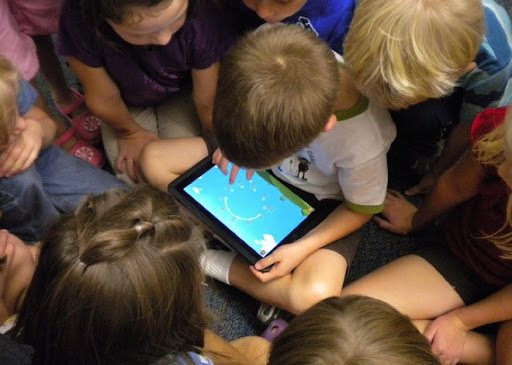 |
| 10 Biggest Questions about iPads in the Classroom |
[Enter site #1 that helped me wrap my brain about iPad deployment in schools]
http://www.scoop.it/t/ipadsineducation
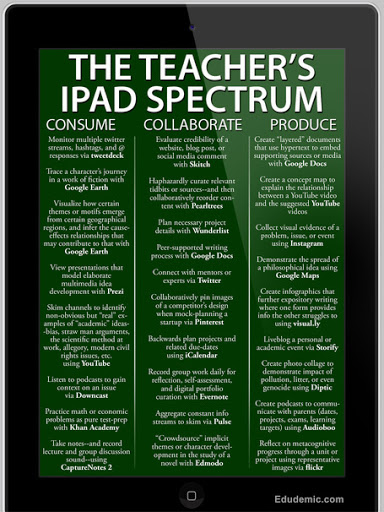
A collection of deployment guides and resources for schools including a presentation on the role of iPads in schools, Apple’s VPP program, and integrating technology into instruction.
Initial roadblocks…
1) iPads are designed to be unique and personalized for their users–the functionality of the iPad (synchronized email, contacts, calendars, apps, iTunes, etc.) does not transfer to school models where iPads are used by multiple students.
 2) iPads are designed to be managed through a home computer, one at a time–Schools who purchased thirty or more iPads for classroom use struggled to painstakingly sync and manage each device, one at a time–a very lengthy and monotonous process (speaking from personal experience). Today, we have a MDM (multiple-device-manager) and a nifty little application that allows a school’s device manager (me) to upload content and manage multiple devices at one time–Apple Configurator.
 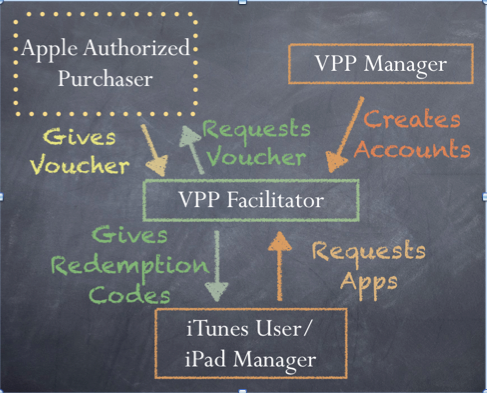 |
| http://wafflebytes.blogspot.com/2011/11/ipads-in-classroom-volume-purchase.html |
They are here!
Ummm…everything is plugged in, why aren’t the dang things charging?
 |
| PowerSync Cart |
The solution? Easy-peasy. Remove the bottom dividers, reach back, and jiggle the power cord to the cart, plug in the wall, flip the switch…and voila! We had power. This took about another hour of our time.
Two hours into our deployment day and we hadn’t even started the iTunes process.
It’s helpful when you have a working iTunes account.
How the heck do we get all of these tools to play nice?
While waiting to hear back about iTunes, we read and re-read, and read again the directions on using Apple Configurator and the Bretford PowerSync cart. [Enter website #1 that saved my sanity].
 Our iTunes delay did allow us to think about the profile we wanted to create for the devices. Apple Configurator not only allows you to upload and manage the content on the iPads, but it also allows you to enable and disable its features to create profiles. For example, the student profile we pushed out to all 30 iPads allows for use of Safari, the built in camera, and it is automatically connected to the Student wifi. Students cannot, however, change the wifi settings, delete or purchase apps, or access iCloud or photo stream. Nice!
While we are waiting…what ARE we going to put on these things?
Thank goodness for Mme. Morgan’s type A personality. The two of us split up and scoured blogs, Pinterest board, websites, and Twitter for lists of recommended apps for education.
[Enter in several more sites that helped us further explore iTunes and the world of apps]
http://appsineducation.blogspot.com/p/maths-ipad-apps.html
apps organized by content area
http://www.educatorstechnology.com/2012/06/blooms-taxonomy-for-ipad.html
apps organized by Bloom’s taxonomy
http://pinterest.com/gcisdtech/ipads/
Pinterest board for iPads in the classroom maintained by GCISD
Finally, let’s load these babies!
Final touches…
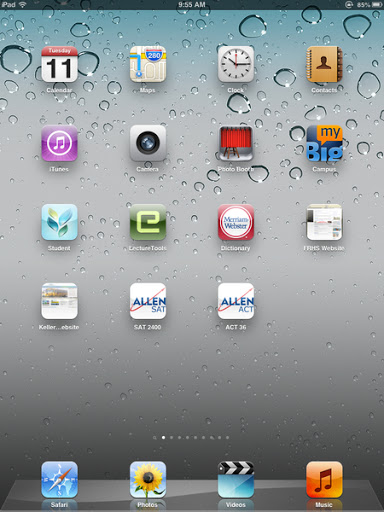
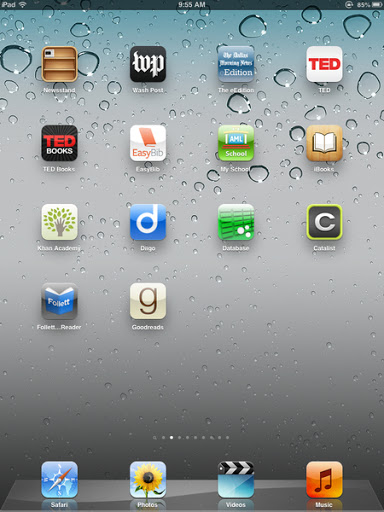
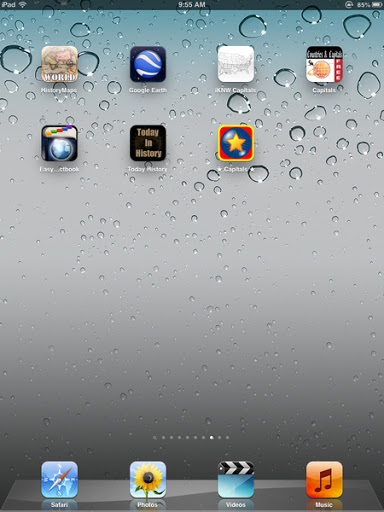
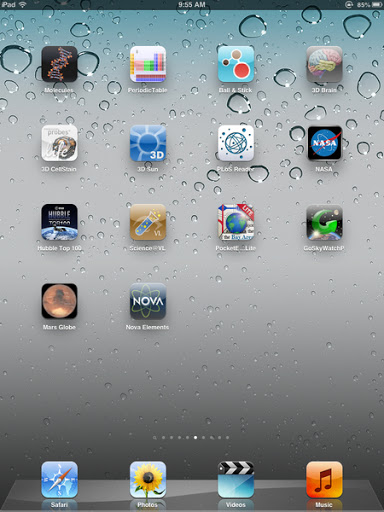
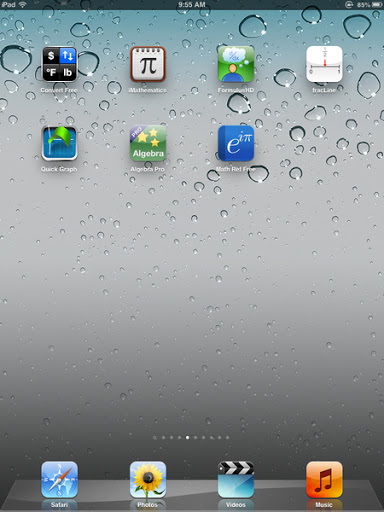
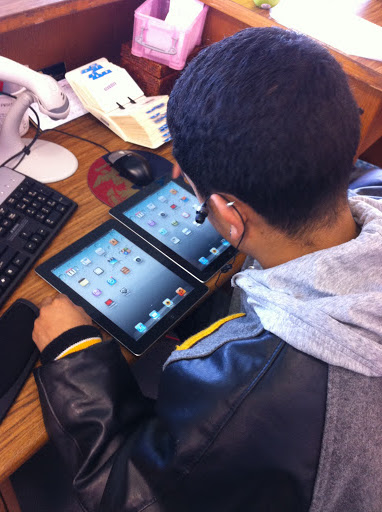 Our final step in preparing the devices for initial use involves manually organizing the apps by functionality and content onto screens so that they are classroom ready. This step must be done one-by-one…thank goodness for savvy student aides!
And the final product:
 |
| Home Screen |
 |
| Read and Explore |
 |
| Social Studies |
 |
|
Foreign Languages
|
 |
|
Science
|
 |
| Math |
 |
| Language Arts |
 Stay tuned for more adventures in iPads!

Module #8: The Raven Boys
 Summary:
Blue has been told since she was very young that she will kill her true love. While watching the ghosts of the soon-to-be-dead walk through churchyard endowed with tremendous spiritual energy, she’s drawn to one spirit, a mysterious boy who speaks directly to her, “Gansey, that’s all there is.” She undergoes a quest with the real Gansey and his three Raven Boys, all students at the prestigious Aglionby Academy, to unearth the powerful ley line and unlock the mystery before someone else beats them to it.
APA Reference:
Stiefvater, M. (2012). The raven boys. New York, NY: Scholastic Press.
Professional Review:
Fiction * The Raven Boys Maggie Stiefvater Scholastic Press, $18.99 (416p) ISBN 978-0-545-42492-9
The Raven Boys [Review of the book The raven boys]. (2012). Publishers Weekly, 259(31), 67.
Impressions:
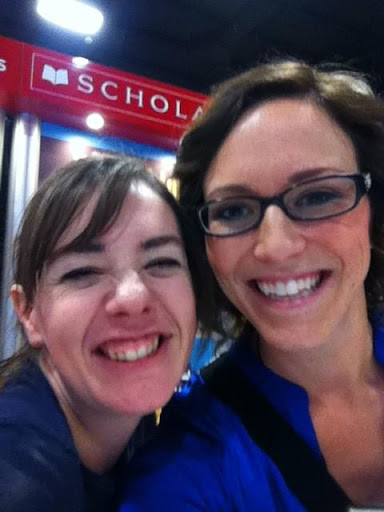 |
| My “BFF” Maggie and Me at NCTE12 |
After devouring Stiefvater’s series The Wolves of Mercy Falls, and her 2011 Printz Honor Book The Scorpio Races, I–and much of the YA-obsessed world–waited eagerly for the release of her “boy” series. Our patience was dually rewarded with this spectaculary, multi-dimensional ensemble story of a band of misfits and their supernatural quest. Much like in The Scorpio Races, Stiefvater deftly crafts a world based in realism with supernatural or mystical elements. Her prose is so well crafted that the reader forgets where the realism ends and fantasy begins. Whether it be ley lines, psychics, and deadly rituals or mythological man-eating water horses, her books do not leave the reader on the outside edge looking into a fantasy.
The ensemble cast of characters truly makes this a “character-driven” novel. Although at times I found myself doubling back and re-reading following abrupt perspectives to the story, I appreciated each character’s unique history, puzzles, and purposes for the quest.
I’m very eager to continue on with Blue in her boys in the next installment.
Favorite moments:
“She recognized the strange happiness that came from loving something without knowing why you did, that strange happiness that was sometimes so big that it felt like sadness.”
“When Gansey was polite, it made him powerful. When Adam was polite, he was giving power away.”
“I guess I make things that need energy stronger. I’m like a walking battery.”
“You’re the table everyone wants at Starbucks,” Gansey mused as he began to walk again.
Blue blinked. “What?”
Over his shoulder, Gansey said, “Next to the wall plug.”
“Where do you live?”
Adam’s mouth was very set. “A place made for leaving”
“That’s not really an answer.”
“It’s not really a place.”
“My words are unerring tools of
destruction, and I’ve come unequipped with the ability to disarm them.”
Library Uses:Both The Raven Boys and The Scorpio Races would make for an excellent bridge between readers who typically enjoy realistic fiction into the fantasy genre. Host a “meet the author” event featuring a new author who has made a strong impact in their genre. Show trailers, provide book talks for participating classes, and invite students to explore Maggie Stiefvater’s website for behind the scene videos into the making of her book trailers for a unique perspective on digital storytelling (www.maggiestiefvater.com).
Module 14: You Don’t Even Know Me
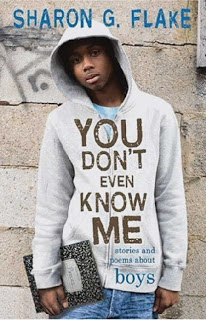
Summary
In this collection of stories and poetry all told from the perspective of teenage boys, Flake presents the sometimes hilarious but reflective voices that are not always heard in classrooms. Some stories deal with very serious topics such as teenage pregnancy and marriage and some are light-hearted takes on girls and how to impress them.
APA Reference
Flake, S. G. (2010). You don’t even know me. New York, NY: Jump at the Sun.
Professional Review
You don’t even know me. Sharon G. Flake. Jump at the Sun, 2010. $16.99. 978-1-4231-0014-0. Grades 8-11. Realistic, sometimes gritty, short stories and some poetry convey life for black, mostly urban, teenage boys. With different formats and themes, the narratives touch on teen pregnancy, AIDS, and violence but also convey a sense of hope and the richness of life.
Impressions
While reading this collection I most appreciated the diversity of the voices represented. Urban male teens tend to be pigeon-holed into one stereotype in pop culture–the hardened thug. Flake, however, shows us the hopes, zeal for life, and the importance of relationships to urban boys.
Library Uses
During National Poetry Month in April, the library can host an open-mic event for students to read from their favorite poets or read their own works. Leading up to the event, create a display of poetry students might find engaging. You Don’t Even Know Me can be part of a display geared towards boys finding their voices through poetry alongside The Rose That Grew From Concrete by Tupac Shakur and many other collections of poetries by urban and male voices. Flake’s poems or stories would make excellent podcasts, recorded with photographs depicting some of the images and scens in the poems.
Module #5: The First Part Last

Summary:
Bobby and his girlfriend Nia are in love and happy, until Nia discovers she is pregnant. Told in alternating chapters between “Now,” Bobby struggles to take care of his newborn daughter without the presence of Nia, and “Then,” Bobby and Nia struggle together to determine what will be best–keep the baby or put her up for adoption. It’s the “first part” of the story that is kept until the very end when we fully understand the situation Bobby finds himself in and the greatest struggle of all.
APA Reference:
Johnson, A. (2003). The first part last. New York, NY: Simon & Schuster Books for Young Readers.
Professional Review:
Section: Grades 9-12
JOHNSON, Angela. The First Part Last.
144p. CIP. S & S. 2003. RTE $15.95.
ISBN 0-689-84922-2. LC 2002036512.
The First Part Last (Book) [Review of the book The first part last]. (2004). School Library Journal, 5064.
Impressions:
First Part Last is such a gentle book, with a deeply sensitive narrator. Reluctant readers will enjoy the short, engaging chapters and the realistic setting and situations. Many will also find familiarity with Bobby’s struggle to be a single, teenage father and the heart-breaking loss he keeps tucked away.
Library Uses:
Paired alongside Flake’s You Don’t Even Know Me, this title could be part of a book talk that targets adolescent boys, particularly those who seem to hide a lot behind the “tough guy” facade.
Module 15: Forever

Summary
A senior in high school, Kath meets Michael at a friend’s New Year’s Eve party and nineteen dates later, they are in love. This isn’t just any kind of love; it’s the kind that lasts forever. The two are inseparable, as Kath works through her confusions and fears about sex and what “making love” will mean for them as a couple. A summer apart tests their trust in one another and belief in “forever.”
APA Reference
Blume, J. (1975). Forever. New York: NY, Atheneum Books for Young Readers.
Professional Review
Katherine and Michael find each other, and it’s first love for both of them. Katherine loses her virginity, finds out about contraceptives, and learns about VD with lectures inserted as needed. Actually, both kids are so kind and considerate, so understanding, so everything, that readers may wonder what’s wrong with them. Finally, she realizes that first love isn’t always Forever, that she is growing and accepting changes. Sniff, sniff. Obviously it’s not a quality book, but that fact won’t bother the many girls who will read it, identify, cry happily, and recommend it to their friends. Librarians buying for junior high schools should be aware that the sexual scenes, while not at all explicit compared to the run of adult novels, may be more than parents of young teens bargain for. —Regina Minduri, Alameda County Library, Hayward, Calif.
Made famous by the many challenges and attempts to ban it from school and public libraries, Blume’s novel is not just about sexual awakening, but of the universal experience of “true” and “first” love; oftentimes, teens first adult experiences are wrapped up in those relationships.
What I most appreciated about Forever is the expansive cast of female characters who all explore varying issues and angles to sexuality: Kath’s best friend Erica who makes it a goal to “get laid” before she goes to college so she can have the experience behind her; Kath’s grandmother, a New York lawyer, who played a pivotal role in the development of Planned Parenthood and sends her pamphlets about birth control, reproductive rights, and venereal disease in the mail, which ultimately leads to Kath visiting the clinic for contraceptives; and, Kath’s mother who has an open and honest relationship with Kath and does not shy away from having non-judgmental conversations about sex without condemning or condoning.
Are there somewhat erotic and overtly sexual moments in Forever? Oh, yes! But, even though sex is an ever present topic, the perspectives and reflections of the characters present a well-rounded conversation that every teenager could benefit from participating in. For some, the only way that will happen is through reading the book.
Library Uses
Forever is an excellent title that appears on the most frequently banned books lists that could be included in a display, book talk, or trailer promoting Banned Book Week. Given the popularity of Judy Blume’s work over the generations, the library could collect personal responses to the novel from adult and teen readers spanning the three decades the book has been popular.
Module #7: Mockingbirds

Book Summary
Alex wakes up in a strange dorm room with a strange boy, evidence of the previous night’s events scattered across the room. It’s clear what happened, but Alex has no memory of any of it after leaving the concert with her friends. As pieces of her memory come back to her and she confides in her best friend and her sister, she realizes the truth–she was date raped. She can stay quiet about it, try to move on with her life, or she can find someone who can help her take a stand. She seeks the assistance of a student organization, The Mockingbirds–named after Harper Lee’s To Kill a Mockingbird. Will they right the wrongs inflicted upon students by fellow students, or will Alex be left standing alone in the end?
APA Reference
Whitney, D. (2012). The mockingbirds. New York, NY: Little Brown.
ImpressionsThe opening chapter as Alex rises from a stranger’s bed, naked and disoriented, paints the picture of a too familiar scene. Whitney approaches the sensitive and sometimes taboo topic of date rape with an honest victim’s perspective. When Alex realizes what has happened to her, we wonder why she doesn’t fight harder, tell the authorities or her parents. Whitney constructs Alex in a way where we not only understand, but we empathize with the many stages of grief she must wade through following a traumatic event. Perhaps the most poignant scene comes right on the heals of resolution. Alex confides in the one adult she trusts to counsel her that she doubts herself and the accusations she’s brought against another student. A vague memory surfaces of that night that makes her question the whole course of events. This realism and honesty stems from Whitney’s personal experiences, which breathe purpose and heroism into her debut novel.
Professional Review
Section: The Book Review
Lehman, C. (2011). The Mockingbirds [Review of the book The Mockingbirds]. School Library Journal, 57(3), 175.
Library Uses
The Mockingbirds fits well with additional titles that address social justice and standing up for those who are dis-empowered. Paired with other books that deal with difficult topics for teens such as Speak by Laurie Halse Anderson, Lay that Trumpet in Our Hands by Susan Carol McCarthy, and Harper Lee’s iconic work, these books allow students to safely explore complex themes. The library may promote these titles by timing a book talk or display with the English department’s study of To Kill a Mockingbird.
 (Re)Inventing the Librarian